In this blog post, we will derive the mirror formula class 12 physics for a concave mirror. You will also get the definition of a spherical mirror, diagram, MCQs, and numerical questions.
Introduction to the Mirror Formula in Ray Optics
In ray optics, spherical mirrors (concave and convex) reflect light to form images. The mirror formula provides a quantitative link between the object’s position, the image’s position, and the mirror’s physical characteristic (the focal length). This formula `(frac {1}{f} = frac{1}{v}+ frac{1}{u})` is valid for both concave and convex mirrors, provided the Cartesian Sign Convention is followed.
What is the Mirror Formula?
The Mirror Formula is a fundamental mathematical relationship used in optics to determine the position and nature of images formed by spherical mirrors. It is expressed as:
`frac{1}{f} = frac{1}{v} + frac{1}{u}`
Where:
f = focal length of the mirror.
v = distance of the image from the pole.
u = distance of the object from the pole.
Derivation of the Mirror Formula for Concave Mirror
Consider a concave mirror with pole O, center C, and focus F on the principal axis. An object PQ is placed perpendicular to the principal axis, forming an image P’Q’.
Ray Rules Used:
- A ray parallel to the principal axis passes through the focus after reflection.
- A ray passing through the center of curvature retraces its path.
Let:
OQ = u (object distance)
OQ’ = v (image distance)
OF = f (focal length)
Ray Diagram Explanation
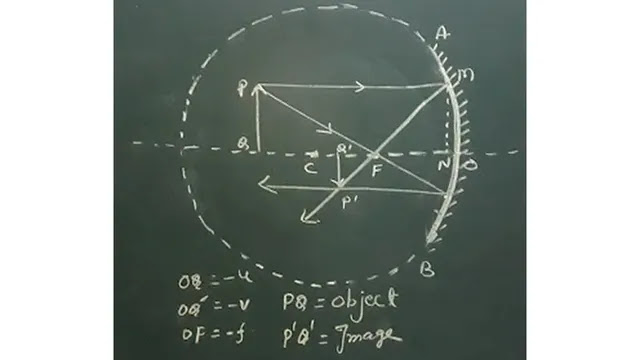 |
| Mirror Formula Derivation |
Step-by-Step Mathematical Derivation
Using similar triangles `triangle OPQ` and `triangle OP’Q’` and applying the Cartesian sign convention,
`frac{P’Q’}{PQ} = frac {OQ’}{OQ}`
`frac{P’Q’}{PQ} = frac {- v}{- u}`
`frac{P’Q’}{PQ} = frac { v}{ u}` …eq. (1)
In triangle MNF and P’Q’F
Let MN be a perpendicular drawn from the focus to the principal axis.
`frac{P’Q’}{MN} = frac {Q’F}{NF}`
`frac{P’Q’}{PQ} = frac {OQ’ – OF}{OF}`
`frac{P’Q’}{PQ} = frac {(-v) – (-f)}{- f}`
`frac{P’Q’}{PQ} = frac {f – v}{- f}`
`frac{P’Q’}{PQ} = frac {-(v-f)}{- f}`
`frac{P’Q’}{PQ} = frac {v-f}{f}` …eq. (2)
By eq. (1) and (2)
`frac { v}{ u} = frac {v-f}{f}`
`vf = u(v-f)`
`vf = uv-uf`
Dividing both sides by uvf, we get :
`frac{vf}{uvf} = frac{uv}{uvf}-frac{uf}{uvf}`
`frac{1}{u} = frac{1}{f}-frac{1}{v}`
`frac{1}{u} + frac{1}{v} = frac{1}{f}`
Final Mirror Formula
`frac{1}{f} = frac{1}{u} + frac{1}{v}`
This is the mirror formula.
Where:
`u =` object distance
`v =` image distance
`f =` focal length
Magnification Formula
Magnification (m) for a concave mirror is the ratio of image height `(h_i)` to object height `(h_o),` and also equals the negative ratio of image distance (v) to object distance (u):
`m = frac{h_i}{h_o} = – frac{v}{u}`
Magnitude
- If `|m|>1,` then the image is enlarged (magnified).
- If `|m|=1,` then the image is the same size as the object.
- If `|m|<1,` then the image is diminished (smaller).
Sign of m
- Positive (+): We use the positive (+) sign for a virtual and erect (right-side up) image.
- Negative (-): We use the negative (-) sign for a real and inverted (upside down) image.
Applications of Mirror Formula
- Design of Optical Instruments.
a. Reflecting Telescopes.
b. Microscopes.
- Quantitative Analysis in Lab Experiments.
- Automotive Safety (rear-View Mirrors).
- Dental and Shaving Mirrors.
- Solar Furnaces and Concentrators.
Conclusion
Frequently Asked Questions (FAQs) on Mirror Formula
Q. What is the mirror formula in physics?
Answer: The mirror formula is a mathematical relation between object distance, image distance, and focal length of a spherical mirror. It is given by:
`frac{1}{f} = frac{1}{u} + frac{1}{v}`
Q. Is the mirror formula applicable to both concave and convex mirrors?
Answer: Yes, the mirror formula is valid for both concave and convex mirrors, provided the Cartesian sign convention is strictly followed.
Q. What is the Cartesian sign convention for the mirror formula?
Answer:
- The pole (P) is the origin.
- The Principal Axis is the x-axis.
- Object is always placed on the left, so u is negative.
- Distances to the left (same side as the object) are negative, to the right are positive.
- Heights upward are positive, downward are negative.
Q. What are the key differences between the formulas for concave and convex mirrors?
- Concave Mirror: Focal length (f) is negative, radius of curvature (R) is negative. It can produce real or virtual images.
- Convex Mirror: Focal length (f) is positive, radius of curvature (R) is positive. It always produces virtual, erect, and diminished images.
Q. What is the formula for magnification?
Answer: Magnification(m) is the ratio of image height to object height (`h_o`), or the ratio of image distance (v) to object distance (u):
`m = frac{h_i}{h_o} = – frac{v}{u}`
If m>0, the image is virtual/erect. If m<0, the image is real/inverted.
Q. Is the mirror formula valid for a plane mirror?
Answer: Yes, the mirror formula can be applied to a plane mirror as well. In that case, the focal length is infinite (f = ∞), and the image is always virtual, erect, and of the same size as the object.
Q. What are the assumptions for deriving the mirror formula?
Answer: The main assumptions are
- The mirror has a small aperture (paraxial rays are considered).
- Rays make small angles with the principal axis.
- The mirror is spherical in shape.
- Laws of reflection are strictly followed.
Q. What are some common mistakes when using the mirror formula?
Answer: Common Mistakes include
- Not using the sign convention for u, v, and f.
- Confusing the mirror formula with the lens formula.
- Forgetting the negative sign in the magnification formula m = – v/u.
Solved Examples
Mirror Formula Numericals in class 12 physics
Q. The radius of curvature of a concave mirror is 50 cm. Find out its focal length.
Sol. Given, R = 50 cm
`f = frac {R}{2}`
`f = frac {50}{2}`
`f = 25 cm` or `f = 0.25 m`
Q. An object is placed at a distance of 10 cm in front of a concave mirror with a radius of curvature of 15 cm. Find the nature of the image, size, and magnification.
Sol. Given, R = – 15 cm `
` f = – frac{15}{2}`
` and u = – 10 cm
From the mirror formula
`frac{1}{u} + frac{1}{v} = frac{1}{f}`
`frac{1}{v} = frac{1}{f} – frac{1}{u}`
`frac{1}{v} = frac{1}{(-frac{15}{2})} – frac{1}{(- 10)}`
`frac{1}{v} = – frac{2}{15} + frac{1}{10}`
`frac{1}{v} = – frac{ – 4 + 3}{30}`
`frac{1}{v} = – frac{ – 1}{30}`
`v = – 30 cm`
Magnification
`m = – frac{v}{u}`
`m = – frac{ – 30}{ -10 }`
`m = – (+ 3)`
`m = – 3 ` (`because` Unitless)
So the image is real, inverted, and three times larger in size and at a 30 cm distance from the mirror.
Test Your Knowledge: Mirror formula MCQs
Q. Mirrors having a curved reflecting surface are called:
(1) plane mirror
(2) spherical mirrors
(3) simple mirror
(4) none of the above
Ans:
(2) spherical mirrors
Q. How many types of spherical mirrors?
(1) 2
(2) 4
(3) 5
(4) 3
Ans:
(1) 2
Hint- There are two types of spherical mirrors: concave mirrors and convex mirrors.
Q. A spherical mirror with a reflecting surface curved inwards is called ……………
(1) Convex mirror
(2) Concave mirror
(3) Curved mirror
(4) None of the above
Ans:
(2) Concave mirror
Q. Types of spherical mirrors are:
(1) Concave mirror
(2) Convex mirror
(3) Both 1 and 2
(4) None of the above
Ans:
(3) Both 1 and 2
Q. Pole lies on the surface of ………………..
(1) spherical mirrors
(2) simple mirror
(3) plane mirror
(4) none of the above
Ans:
(1) spherical mirrors
Q. The Pole is generally represented by ……………
(1) R
(2) P
(3) C
(4) O
Ans:
(2) P
Q. The center of a sphere of which the reflecting surface of a spherical mirror is a part is called ……………
(1) Pole
(2) Centre of curvature
(3) The radius of Curvature
(4) Aperture
Ans:
(2) Centre of Curvature
Q. The Centre of curvature is not a part of the spherical mirror, rather it lies ………….. the mirror
(1) boundary
(2) Inside
(3) outside
(4) none of the above
Ans:
(3) outside
Q. In the case of a concave mirror center of curvature lies in ………… of the reflecting surface
(1) Boundary
(2) Inside
(3) Outside
(4) Front
Ans:
(4) Front
Q. The light reflected by a plane mirror may form a real image
(1) If the rays incident on the mirror are converging.
(2) Under no circumstances
(3) If the object is placed very close to the mirror.
(4) If the rays incident on the mirror are diverging.
Ans:
(1) If the rays incident on the mirror are converging.
Q. In image formation from spherical mirrors, only paraxial rays are considered because they
(1) Form is nearly a point image of a point source.
(2) Show minimum dispersion effect.
(3) Contain most of the intensity of the incident light.
(4) Are easy to handle geometrically.
Ans:
(1) Form nearly a point image of a point source.
Q. For reflection through spherical surfaces, the normal at the point of incidence is
(1) Perpendicular to the tangent plane at the point of incidence and passes through the center of curvature
(2) Perpendicular to the tangent plane at the pole and passes through the focus.
(3) Perpendicular to the focal plane and passes through the pole.
(4) Perpendicular to the principal axis and passes through the center of curvature
Ans:
(1) Perpendicular to the tangent plane at the point of incidence and passes through the center of curvature
Q. A convex mirror is used to form the image of an object. Then which of the following statements is/are true?
i) The Image lies between the pole and the focus
ii) The image is diminished in size
iii) The image is real
(1) i and ii
(2) ii only
(3) i only
(4) i and iii
Ans:
(1) i and ii
Q. A person is six feet tall. How tall must a plane mirror be if he is able to see his entire length?
(1) 3 ft
(2) 4.5 ft
(3) 7.5 ft
(4) 6 ft
Ans:
(1) 3 ft
Q. Which of the following is an incorrect statement?
(1) A real, inverted, same-sized image can be formed using a convex mirror
(2) A virtual, magnified image can be formed using a concave mirror
(3) A virtual, erect, same-sized image can be obtained using a plane mirror
(4) The magnification produced by a convex mirror is always less than one
Ans:
(1) A real, inverted, same-sized image can be formed using a convex mirror
Q. A rod of length 10 cm lies along the principal axis of a concave mirror of focal length 10 cm in such a way that its end closer to the pole is 20 cm away from the mirror. The length of the image is
(1) 5 cm
(2) 2.5 cm
(3) 15 cm
(4) 10 cm
Ans:
(1) 5 cm
Q. Two plane mirrors are inclined to each other at a certain angle. A ray of light first incident on one of them at an inclination of `10^circ` with the mirror retraces its path after five reflections. The angle between the mirrors is
(1) `20^circ`
(2) `30^circ`
(3) `22^circ`
(4) `12^circ`
Ans:
(1) `20^circ`
Q. A concave mirror is placed on a horizontal table with its axis directed vertically upwards. Let O be the pole of the mirror and C be its center of curvature. A mirror is now filled with water, and the image will be
(1) Real, and located at a point between C and O
(2) Real, and will remain at C
(3) Virtual, and located at a point between C and O
(4) None of these
Ans:
(1) Real, and located at a point between C and O
Call to Action (CTA)
If you found this post helpful, don’t stop here-take your preparation to the next level with structured resources and guided learning.
- Free notes PDF (Coming Soon)-Quick revision notes & formulas.
- Join Physics365 WhatsApp-Get daily questions & updates.
- Watch Full Video-Search “Continuous Charge Distribution Physics 365” on YouTube or Google.
👉Don’t just read, start practicing and boost your score today!
If you found this post helpful, don’t stop here-take your preparation to the next level with structured resources and guided learning.
- Free notes PDF (Coming Soon)-Quick revision notes & formulas.
- Join Physics365 WhatsApp-Get daily questions & updates.
- Watch Full Video-Search “Continuous Charge Distribution Physics 365” on YouTube or Google.
👉Don’t just read, start practicing and boost your score today!