Earthworm: Morphology and Anatomy
.png "earthworm morphology")
Introduction
In this post, you will learn about Earthworm morphology and anatomy, including external structure, body wall, digestive system, circulatory system, nervous system, excretory system, reproductive system, and importance of earthworms in a simple and exam-oriented way. Earthworm is an important topic for Class 11 Biology, NEET preparation, practical exams, and viva questions.
Classification of Earthworm
Kingdom: Animalia
Phylum: Annelida
Class: Oligochaeta
Genus: Pheretima
Earthworms belong to phylum Annelida because their body is segmented and bilaterally symmetrical.
Habit and Habitat of Earthworm
Earthworms are terrestrial animals commonly found in moist soil rich in organic matter. They live in burrows and remain active mainly during the rainy season or at night.
Earthworms are also called “farmer’s friends” because they improve soil fertility.
Earthworm Labelled Diagram
Suggested diagrams to include:
External morphology of earthworm
Digestive system of earthworm
Reproductive system of earthworm
Nervous system of earthworm
These diagrams improve practical preparation, image SEO, and student understanding.
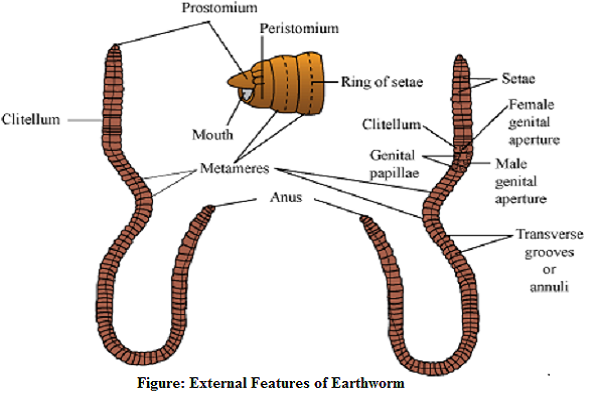
External Morphology of Earthworm
The body of an earthworm is long, cylindrical, soft, and metamerically segmented.
Important External Features
Shape and Size
Body is elongated and bilaterally symmetrical
Length usually ranges from 10–30 cm depending on species
Segmentation
Body consists of many ring-like segments called metameres
Segmentation is externally visible
Color
Dorsal surface is dark brown
Ventral surface is lighter
Anterior End
Mouth is present on the first segment
A lobe-like structure called prostomium overhangs the mouth
Posterior End
Anus is present on the last segment
Clitellum in Earthworm
The clitellum is a thick, glandular band present around segments 14–16.
Functions of Clitellum
Secretes mucus during copulation
Helps in cocoon formation
The presence of clitellum indicates sexual maturity.
Setae in Earthworm
Setae are tiny bristle-like structures present in most body segments except the first, last, and clitellar segments.
Functions
Help in locomotion
Provide grip in soil
Body Wall of Earthworm
The body wall consists of the following layers:
Cuticle
Epidermis
Circular muscles
Longitudinal muscles
Coelomic epithelium
The body cavity is a true coelom filled with coelomic fluid.
Coelom in Earthworm
Earthworm is a true coelomate animal.
Functions of Coelomic Fluid
Maintains body shape
Helps in locomotion
Transports nutrients and wastes
Digestive System of Earthworm
The digestive tract is complete and extends from mouth to anus.
Parts of Digestive System
Mouth
Ingestion of food occurs here.
Buccal Cavity
Receives food from the mouth.
Pharynx
Muscular organ that pushes food forward.
Esophagus
Narrow tube conducting food.
Gizzard
Muscular organ that grinds food particles.
Stomach
Partial digestion occurs here.
Intestine
Main site of digestion and absorption.
Typhlosole
Internal fold in the intestine that increases absorptive surface area.
Anus
Undigested food is expelled through the anus.
Nutrition in Earthworm
Earthworms show holozoic nutrition and feed mainly on decaying organic matter present in soil.
Steps of Nutrition
Ingestion
Digestion
Absorption
Assimilation
Egestion
Earthworms are important decomposers in ecosystems.
Respiratory System of Earthworm
Earthworms do not possess specialized respiratory organs.
Respiration
Occurs through moist body surface
Oxygen diffuses into blood capillaries
Carbon dioxide diffuses out
This type of respiration is called cutaneous respiration.
Circulatory System of Earthworm
Earthworm has a closed circulatory system.
Important Features
Blood flows through blood vessels
Dorsal blood vessel collects blood
Ventral blood vessel distributes blood
Aortic arches act as hearts
Functions
Transport of nutrients
Transport of respiratory gases
Removal of wastes
Excretory System of Earthworm
Excretion occurs through nephridia.
Types of Nephridia
Septal Nephridia
Present on septa inside the body.
Integumentary Nephridia
Present in body wall.
Pharyngeal Nephridia
Present near pharynx.
Functions
Removal of nitrogenous wastes
Osmoregulation
Earthworms are mainly ammonotelic.
Nervous System of Earthworm
Earthworm has a well-developed nervous system.
Main Parts
Cerebral Ganglia
Acts as a simple brain.
Circumpharyngeal Connectives
Connect brain to ventral nerve cord.
Ventral Nerve Cord
Runs along the ventral side of body.
Functions
Coordination
Response to stimuli
Control of body activities
Reproductive System of Earthworm
Earthworms are hermaphrodites because both male and female reproductive organs are present in the same individual.
Male Reproductive Organs
Testes
Seminal vesicles
Spermiducal funnels
Female Reproductive Organs
Ovaries
Oviducts
Fertilization
Cross-fertilization usually occurs
Cocoon formation takes place after mating
Locomotion in Earthworm
Locomotion occurs with the help of muscles and setae.
Mechanism
Circular muscles elongate body
Longitudinal muscles shorten body
Setae provide anchorage
This movement is called creeping locomotion.
Economic Importance of Earthworm
Useful Activities
Improves soil fertility
Helps in decomposition
Increases soil aeration
Used in vermicomposting
Because of these benefits, earthworms are called “friends of farmers.”
Identification Features of Earthworm
Long cylindrical segmented body
Bilateral symmetry
Presence of clitellum
Setae for locomotion
True coelom
Closed circulatory system
Why Earthworm is Important for Exams
Frequently asked in Class 11 Biology
Important for NEET and practical exams
Common source of viva questions
Diagram-based topic
Quick Revision Points
Earthworm belongs to phylum Annelida.
Body is metamerically segmented.
Respiration occurs through moist skin.
Circulatory system is closed.
Excretion occurs through nephridia.
Earthworms are hermaphrodites.
Locomotion occurs with muscles and setae.
Viva Questions
Why are earthworms called farmer’s friends?
Answer: Because they improve soil fertility and aeration.
Explanation: Earthworms mix and loosen soil while decomposing organic matter.
What is the function of setae?
Answer: Setae help in locomotion.
Explanation: They provide grip and anchorage in soil.
Which organ grinds food in earthworm?
Answer: Gizzard
Explanation: The muscular gizzard crushes food particles.
What type of circulatory system is present in earthworm?
Answer: Closed circulatory system
Explanation: Blood remains confined within blood vessels.
MCQs on Earthworm
Earthworm belongs to which phylum?
(a) Arthropoda
(b) Mollusca
(c) Annelida
(d) Nematoda
Answer: (c) Annelida
Explanation: Earthworm has a segmented body characteristic of annelids.
Which structure helps in locomotion in earthworm?
(a) Nephridia
(b) Setae
(c) Typhlosole
(d) Clitellum
Answer: (b) Setae
Explanation: Setae provide grip during movement.
Respiration in earthworm occurs through:
(a) Gills
(b) Trachea
(c) Skin
(d) Lungs
Answer: (c) Skin
Explanation: Earthworms perform cutaneous respiration.
Which organ grinds food in earthworm?
(a) Crop
(b) Intestine
(c) Gizzard
(d) Pharynx
Answer: (c) Gizzard
Explanation: Gizzard mechanically grinds food particles.
FAQ
Is earthworm a vertebrate or invertebrate?
Earthworm is an invertebrate because it does not possess a backbone.
Why is earthworm called a true coelomate?
Earthworm possesses a true coelom completely lined by mesoderm.
What is the function of clitellum?
The clitellum helps in cocoon formation during reproduction.
Keywords
earthworm morphology, earthworm anatomy, earthworm digestive system, earthworm reproductive system, earthworm diagram, earthworm notes class 11, annelida characteristics, earthworm NEET notes, earthworm anatomy and physiology, earthworm labelled diagram