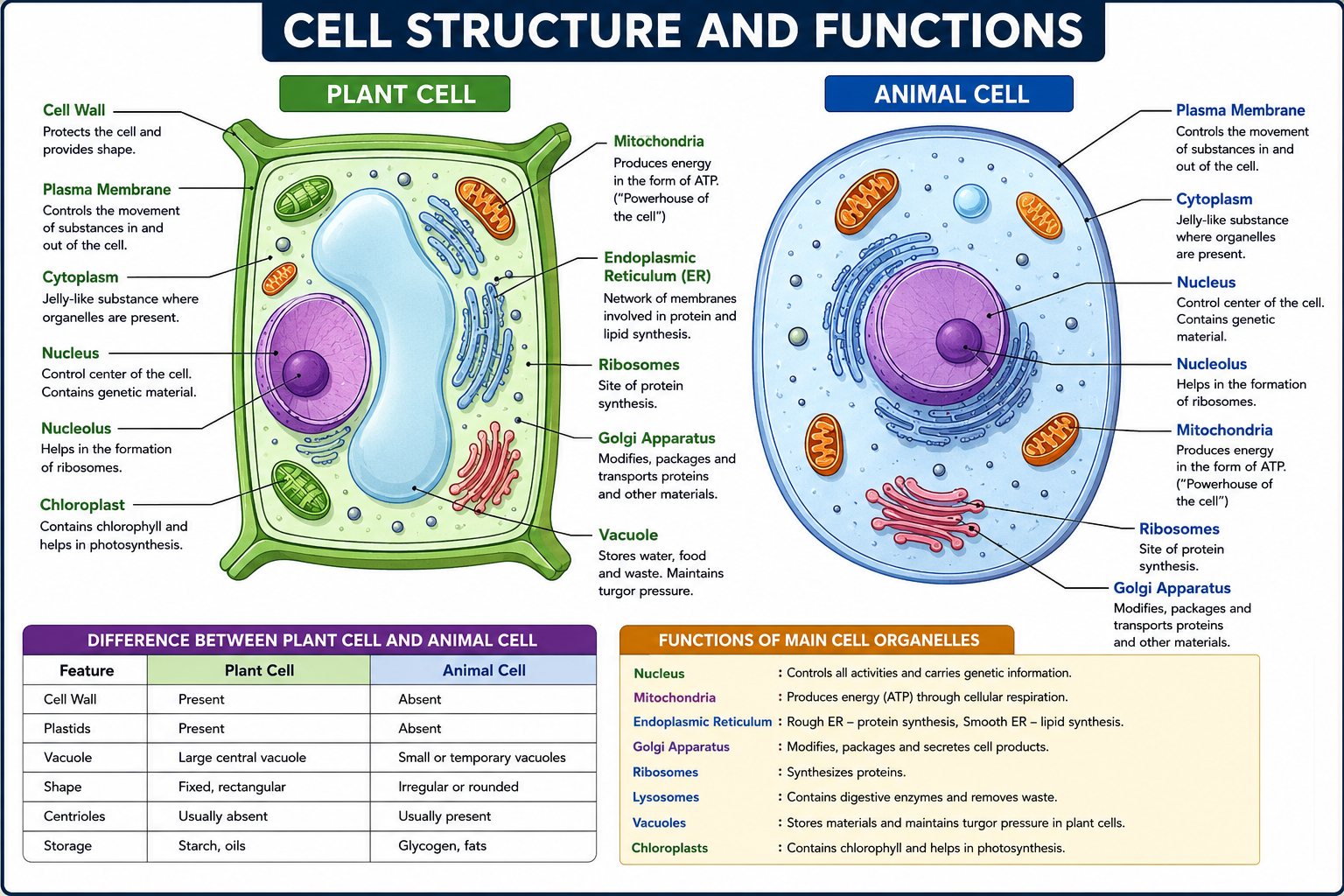
Cell Structure and Functions | Class 10 Science Notes
 |
|
|
Introduction
In this post, you will learn about cell structure and functions, including the discovery of cells, cell theory, types of cells, cell organelles, plant cell, animal cell, and the functions of different parts of the cell in a simple and exam-oriented way. This topic is important for Class 10 Science, foundation biology, board exams, and NEET preparation.
The cell is the basic structural and functional unit of life. All living organisms are made up of cells.
Discovery of Cell
The cell was first discovered by Robert Hooke in 1665 while observing a thin slice of cork under a microscope.
Later, Anton van Leeuwenhoek observed living cells for the first time.
Cell Theory
Cell theory was proposed by Schleiden and Schwann.
Main Points of Cell Theory
All living organisms are made up of cells.
The cell is the basic structural and functional unit of life.
New cells arise from pre-existing cells.
The third point was added later by Rudolf Virchow.
What is a Cell?
A cell is the smallest living unit capable of performing all basic life processes.
Functions of Cells
Growth
Respiration
Nutrition
Excretion
Reproduction
Types of Cells
Cells are mainly of two types:
Prokaryotic Cells
Primitive cells
No true nucleus
Membrane-bound organelles absent
Example
Bacteria
Eukaryotic Cells
Advanced cells
True nucleus present
Membrane-bound organelles present
Examples
Plant cells
Animal cells
Shape and Size of Cells
Cells may vary in shape and size.
Examples
Nerve cell → long and branched
Red blood cell → circular and biconcave
Muscle cell → elongated
The shape of a cell is related to its function.
Structure of Cell
A typical cell consists of three main parts:
Plasma membrane
Cytoplasm
Nucleus
Plasma Membrane
The plasma membrane is the outer covering of the cell.
Functions of Plasma Membrane
Protects the cell
Gives shape to the cell
Controls movement of substances in and out of the cell
The plasma membrane is selectively permeable.
Cell Wall
The cell wall is present only in plant cells.
Characteristics
Made of cellulose
Freely permeable
Rigid and non-living
Functions
Provides shape
Gives protection
Prevents bursting of the cell
Cytoplasm
Cytoplasm is the jelly-like substance present between the plasma membrane and nucleus.
Functions of Cytoplasm
Contains cell organelles
Site of metabolic activities
Helps in transport of materials
Cell Organelles and Their Functions
Cell organelles are specialized structures that perform specific functions.
Nucleus
The nucleus is the control center of the cell.
Structure of Nucleus
Nuclear membrane
Nucleoplasm
Nucleolus
Chromatin
Functions
Controls cell activities
Stores genetic material
Helps in cell division
Mitochondria
Mitochondria are called the “powerhouse of the cell.”
Functions
Produce energy in the form of ATP
Carry out cellular respiration
Mitochondria contain their own DNA.
Endoplasmic Reticulum (ER)
The ER is a network of membranes present in cytoplasm.
Types of ER
Rough ER
Ribosomes present
Protein synthesis
Smooth ER
Ribosomes absent
Lipid synthesis
Golgi Apparatus
Golgi apparatus consists of flattened sacs called cisternae.
Functions
Packaging of substances
Secretion
Formation of lysosomes
Ribosomes
Ribosomes are small granules present in cytoplasm.
Function
Protein synthesis
Lysosomes
Lysosomes contain digestive enzymes.
Functions
Intracellular digestion
Removal of damaged organelles
They are called the “suicidal bags” of the cell.
Vacuoles
Vacuoles are storage sacs present in cells.
Functions
Store food and water
Maintain turgor pressure
Plant cells usually contain large vacuoles.
Plastids
Plastids are present in plant cells.
Types of Plastids
Chloroplast
Contains chlorophyll and performs photosynthesis.
Chromoplast
Contains colored pigments.
Leucoplast
Stores food materials.
Difference Between Plant Cell and Animal Cell
| Feature | Plant Cell | Animal Cell |
|---|---|---|
| Cell wall | Present | Absent |
| Plastids | Present | Absent |
| Vacuole | Large | Small |
| Shape | Fixed | Irregular |
Functions of Cell
Provides structure
Performs metabolic activities
Helps in growth
Stores genetic information
Produces energy
Importance of Cell
Basic unit of life
Helps in growth and repair
Essential for body functioning
Important in heredity
Why This Topic is Important for Exams
Frequently asked in Class 10 Science exams
Important for foundation NEET preparation
Diagram-based questions are common
Helps in understanding advanced biology
Quick Revision Notes
Cell is the basic unit of life.
Robert Hooke discovered the cell.
Plasma membrane is selectively permeable.
Nucleus controls cellular activities.
Mitochondria produce ATP.
Ribosomes synthesize proteins.
Plant cells possess cell wall and plastids.
Viva Questions
Who discovered the cell?
Answer: Robert Hooke
Explanation: He observed cork cells under a microscope in 1665.
Which organelle is called the powerhouse of the cell?
Answer: Mitochondria
Explanation: They produce energy in the form of ATP.
What is the function of ribosomes?
Answer: Protein synthesis
Explanation: Ribosomes help in making proteins.
Why is the plasma membrane called selectively permeable?
Answer: Because it allows only selected substances to pass through.
Explanation: It regulates movement of materials in and out of the cell.
MCQs on Cell Structure and Functions
Who discovered the cell?
(a) Darwin
(b) Robert Hooke
(c) Leeuwenhoek
(d) Mendel
Answer: (b) Robert Hooke
Explanation: Robert Hooke discovered cells while observing cork.
Which organelle is called the powerhouse of the cell?
(a) Nucleus
(b) Ribosome
(c) Mitochondria
(d) Vacuole
Answer: (c) Mitochondria
Explanation: Mitochondria produce ATP through respiration.
Which structure is present only in plant cells?
(a) Plasma membrane
(b) Nucleus
(c) Cell wall
(d) Cytoplasm
Answer: (c) Cell wall
Explanation: The cell wall is characteristic of plant cells.
Ribosomes are mainly responsible for:
(a) Respiration
(b) Protein synthesis
(c) Excretion
(d) Digestion
Answer: (b) Protein synthesis
Explanation: Ribosomes synthesize proteins.
Frequently Asked Questions (FAQs)
What is the basic unit of life?
The cell is the basic structural and functional unit of life.
Why are mitochondria called powerhouse of the cell?
Because they produce energy in the form of ATP.
What is the function of nucleus?
The nucleus controls cellular activities and contains genetic material.
Which organelle performs photosynthesis?
Chloroplast performs photosynthesis in plant cells.
Suggested Diagrams
Plant cell labelled diagram
Animal cell labelled diagram
Structure of nucleus
Structure of mitochondria
These diagrams improve exam preparation and understanding.
Keywords
cell structure and functions, cell structure class 10, cell notes for class 10, plant cell and animal cell, cell organelles and functions, nucleus function, mitochondria function, cell theory, class 10 science notes, biology notes on cell