Tissues in Plants and Animals | Science Notes
 |
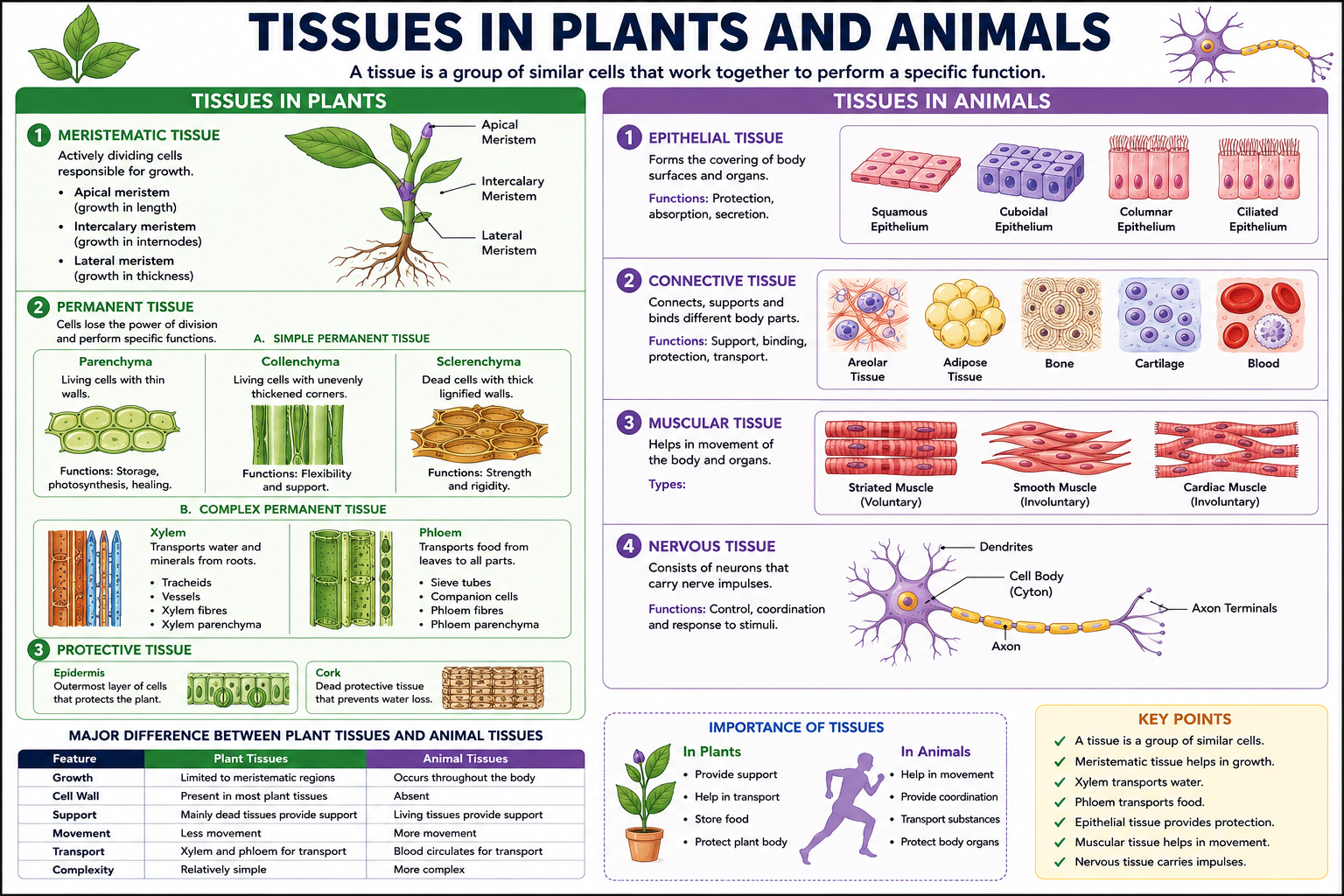
| Class 9 Biology diagram explaining tissues in plants and animals with labelled examples of plant tissues, animal tissues, and their major functions for board exams and NEET foundation preparation. |
Introduction
In this post, you will learn about tissues in plants and animals, their types, structure, functions, and differences in a simple and exam-oriented way. This topic is important for Class 9 Science, foundation biology, board exams, NEET preparation, practical exams, and viva questions.
In multicellular organisms, similar cells group together to perform specific functions. Such groups of cells are called tissues. Tissues help organisms carry out different life processes efficiently.
What is a Tissue?
A tissue is a group of similar cells that work together to perform a specific function.
Examples
Muscle tissue helps in movement.
Xylem tissue transports water in plants.
Nervous tissue carries messages in the body.
The study of tissues is called histology.
Why are Tissues Important?
Tissues provide division of labour in multicellular organisms.
Importance of Tissues
Increase efficiency of body functions
Help in specialization
Improve coordination
Support growth and repair
Tissues in Plants
Plant tissues are mainly divided into two types:
Meristematic tissue
Permanent tissue
Meristematic Tissue
Meristematic tissues contain actively dividing cells responsible for plant growth.
Characteristics
Cells divide continuously
Thin cell walls
Dense cytoplasm
Large nucleus
Vacuoles absent or very small
Types of Meristematic Tissue
Apical Meristem
Present at the tips of roots and shoots.
Function
Increases the length of the plant.
Intercalary Meristem
Present at the base of leaves or internodes.
Function
Helps in rapid growth of stems and leaves.
Lateral Meristem
Present along the sides of stems and roots.
Function
Increases the thickness of the plant.
Permanent Tissue
Permanent tissues are formed from meristematic tissues after cell division stops.
Characteristics
Cells lose the power of division
Definite shape and size
Specialized functions
Permanent tissues are of two types:
Simple permanent tissue
Complex permanent tissue
Simple Permanent Tissue
Simple permanent tissues are made of similar types of cells.
Types of Simple Permanent Tissue
Parenchyma
Parenchyma consists of living cells with thin walls.
Functions
Storage of food
Photosynthesis
Healing and repair
Special Types:
Chlorenchyma → contains chlorophyll
Aerenchyma → contains air spaces
Collenchyma
Collenchyma consists of elongated living cells with unevenly thickened corners.
Functions
Provides flexibility
Gives mechanical support
Sclerenchyma
Sclerenchyma consists of dead cells with thick lignified walls.
Functions
Provides strength
Makes plant parts hard and rigid
Examples:
Coconut husk
Seed coat
Complex Permanent Tissue
Complex tissues are made of different types of cells working together.
Types
Xylem
Xylem transports water and minerals from roots to other parts of the plant.
Components of Xylem
Tracheids
Vessels
Xylem fibres
Xylem parenchyma
Phloem
Phloem transports food prepared in leaves to all body parts.
Components of Phloem
Sieve tubes
Companion cells
Phloem fibres
Phloem parenchyma
Protective Tissue
Protective tissues protect plants from injury and water loss.
Types
Epidermis
Outermost layer of cells
Protects plant body
Cork
Dead protective tissue
Prevents water loss
Tissues in Animals
Animal tissues are mainly divided into four types:
Epithelial tissue
Connective tissue
Muscular tissue
Nervous tissue
Epithelial Tissue
Epithelial tissue forms the outer covering of body surfaces and organs.
Functions
Protection
Absorption
Secretion
Types
Squamous epithelium
Cuboidal epithelium
Columnar epithelium
Ciliated epithelium
Connective Tissue
Connective tissue connects and supports different body parts.
Functions
Binding
Support
Protection
Transport
Types
Areolar tissue
Adipose tissue
Bone
Cartilage
Blood
Muscular Tissue
Muscular tissue helps in movement.
Types of Muscular Tissue
Striated Muscle
Voluntary muscles
Attached to bones
Smooth Muscle
Involuntary muscles
Found in internal organs
Cardiac Muscle
Present in heart
Involuntary and rhythmic
Nervous Tissue
Nervous tissue consists of nerve cells called neurons.
Functions
Carry nerve impulses
Control coordination
Respond to stimuli
Difference Between Plant Tissues and Animal Tissues
| Feature | Plant Tissues | Animal Tissues |
|---|---|---|
| Growth | Limited to meristematic regions | Occurs throughout body |
| Support | Mainly dead tissues provide support | Living tissues provide support |
| Movement | Less movement | More movement |
| Complexity | Simpler | More complex |
Importance of Tissues
In Plants
Provide support
Help in transport
Store food
Protect plant body
In Animals
Help in movement
Coordination
Transport
Protection
Identification Features
Plant Tissues
Presence of xylem and phloem
Meristematic regions
Cell walls present
Animal Tissues
Muscle fibres
Neurons
Connective structures
Why This Topic is Important for Exams
Frequently asked in Class 9 Science exams
Important for NEET foundation preparation
Diagram-based questions are common
Important for understanding plant and animal organization
Quick Revision Notes
Tissue is a group of similar cells.
Meristematic tissue helps in growth.
Xylem transports water.
Phloem transports food.
Epithelial tissue provides protection.
Muscular tissue helps in movement.
Nervous tissue carries impulses.
Viva Questions
What is a tissue?
Answer: A group of similar cells performing a specific function.
Explanation: Tissues help in division of labour.
Which tissue transports water in plants?
Answer: Xylem
Explanation: Xylem carries water and minerals from roots.
Which tissue helps in movement?
Answer: Muscular tissue
Explanation: Muscles contract and relax to produce movement.
What is the function of nervous tissue?
Answer: Transmission of nerve impulses.
Explanation: It controls coordination and responses.
MCQs on Tissues
Which tissue transports food in plants?
(a) Xylem
(b) Phloem
(c) Parenchyma
(d) Sclerenchyma
Answer: (b) Phloem
Explanation: Phloem carries prepared food throughout the plant.
Which tissue provides flexibility in plants?
(a) Sclerenchyma
(b) Collenchyma
(c) Xylem
(d) Cork
Answer: (b) Collenchyma
Explanation: Collenchyma provides flexible support.
Which tissue is present in the heart?
(a) Smooth muscle
(b) Cardiac muscle
(c) Striated muscle
(d) Nervous tissue
Answer: (b) Cardiac muscle
Explanation: Cardiac muscles are found only in the heart.
Which tissue carries nerve impulses?
(a) Epithelial tissue
(b) Connective tissue
(c) Nervous tissue
(d) Muscular tissue
Answer: (c) Nervous tissue
Explanation: Neurons transmit nerve impulses.
Frequently Asked Questions (FAQs)
What are tissues?
Tissues are groups of similar cells working together to perform specific functions.
Which tissue helps plants grow?
Meristematic tissue helps in plant growth.
What is the function of xylem?
Xylem transports water and minerals.
Which animal tissue helps in movement?
Muscular tissue helps in movement.
Suggested Diagrams
Types of plant tissues
Xylem and phloem diagram
Neuron structure
Types of muscular tissue
These diagrams improve understanding and exam preparation.
Keywords
tissues in plants and animals, plant tissues and animal tissues, tissues class 9 notes, meristematic tissue, permanent tissue, xylem and phloem, epithelial tissue, muscular tissue, nervous tissue, biology notes class 9