Table of Contents
TogglePlasma Membrane and Cell Wall | Class 10 Science Notes
 |
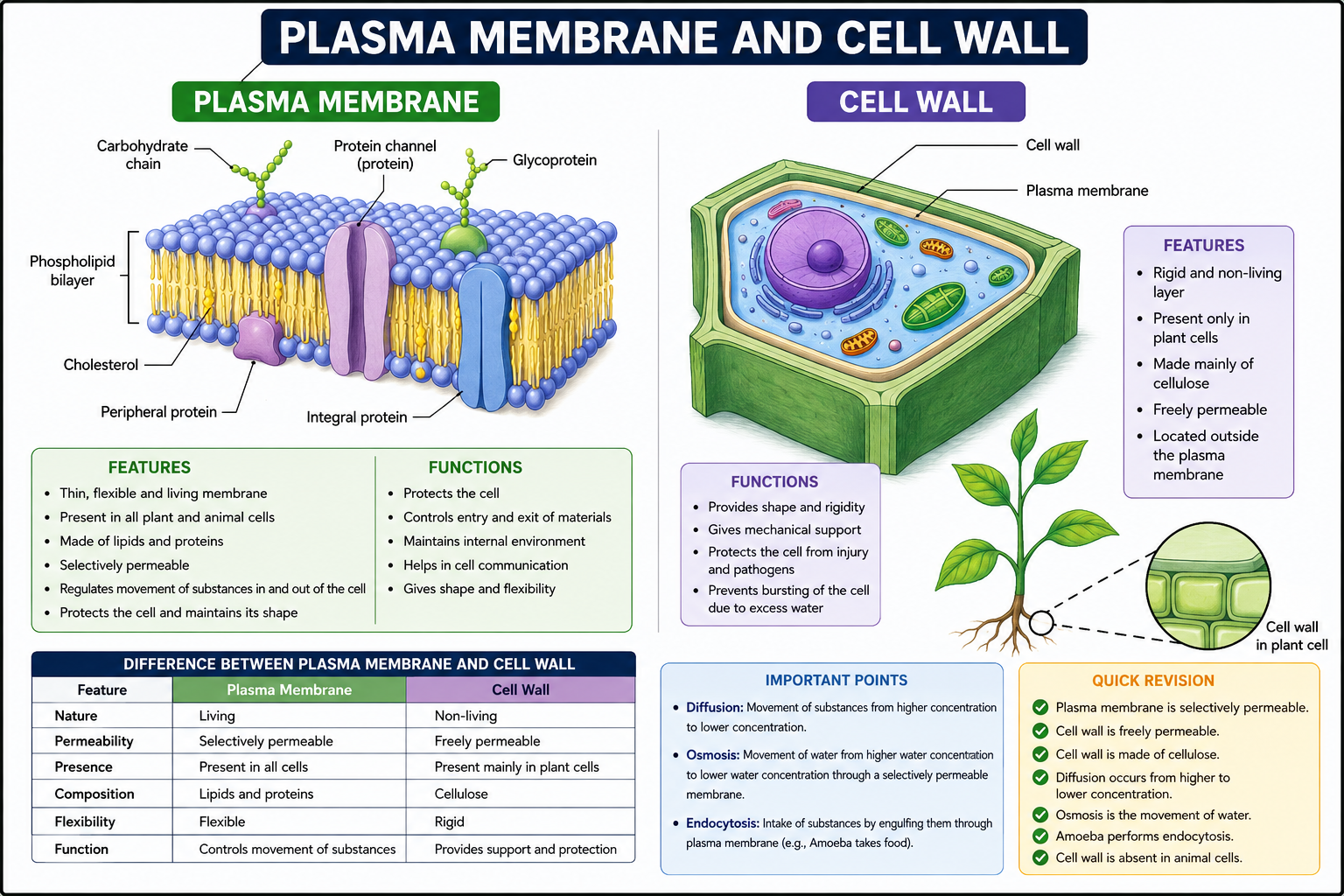
| Class 10 Biology diagram explaining plasma membrane and cell wall structure, selective permeability, diffusion, osmosis, and major functions in cells. |
Introduction
In this post, you will learn about the plasma membrane and cell wall, including their structure, functions, properties, differences, and importance in a simple and exam-oriented way. This topic is important for Class 10 Science, foundation biology, NEET preparation, practical exams, and viva questions.
Every cell is surrounded by a protective covering that helps maintain its shape and controls the movement of substances. In living cells, the plasma membrane is present in all organisms, while the cell wall is mainly found in plant cells.
What is Plasma Membrane?
The plasma membrane, also called the cell membrane, is a thin, flexible outer covering present around the cytoplasm of the cell.
It separates the internal contents of the cell from the external environment and regulates the movement of materials in and out of the cell.
Structure of Plasma Membrane
The plasma membrane is mainly made of lipids and proteins.
Important features:
Thin and flexible
Living membrane
Present in both plant and animal cells
Selectively permeable in nature
The plasma membrane surrounds the cytoplasm and protects the internal cell organelles.
Functions of Plasma Membrane
The plasma membrane performs several important functions necessary for cell survival.
Main Functions
Protection
It protects the internal parts of the cell from external damage.
Regulation of Substances
The membrane controls the entry and exit of materials such as water, gases, nutrients, and wastes.
Gives Shape to the Cell
It helps maintain the shape and structure of the cell.
Communication
The plasma membrane helps cells interact with their surroundings.
Selective Permeability
The plasma membrane is called selectively permeable because it allows only selected substances to pass through it.
This property helps maintain the internal balance of the cell.
Diffusion
Diffusion is the movement of substances from a region of higher concentration to a region of lower concentration.
Example
Exchange of oxygen and carbon dioxide through the cell membrane occurs by diffusion.
Osmosis
Osmosis is the movement of water molecules through a selectively permeable membrane from a region of higher water concentration to lower water concentration.
Water movement in plant cells mainly occurs through osmosis.
Endocytosis
Endocytosis is the process by which a cell takes in substances by engulfing them through the plasma membrane.
Example
Amoeba takes in food by endocytosis.
What is Cell Wall?
The cell wall is a rigid, non-living outer covering present outside the plasma membrane in plant cells.
It is mainly made of cellulose.
The cell wall provides extra protection and support to the cell.
Structure of Cell Wall
Important characteristics of the cell wall:
Non-living layer
Freely permeable
Rigid and strong
Made mainly of cellulose
The cell wall is absent in animal cells.
Functions of Cell Wall
The cell wall performs several important functions in plant cells.
Main Functions
Protection
Protects the plant cell from injury and external factors.
Mechanical Support
Provides rigidity and support to the plant body.
Maintains Shape
Helps maintain the fixed shape of plant cells.
Prevents Bursting
Protects cells from bursting when excess water enters.
Difference Between Plasma Membrane and Cell Wall
| Feature | Plasma Membrane | Cell Wall |
|---|---|---|
| Nature | Living | Non-living |
| Permeability | Selectively permeable | Freely permeable |
| Presence | Present in all cells | Present mainly in plant cells |
| Composition | Lipids and proteins | Cellulose |
| Flexibility | Flexible | Rigid |
Importance of Plasma Membrane and Cell Wall
Both structures are essential for the proper functioning of cells.
Importance of Plasma Membrane
Maintains internal environment
Controls transport of substances
Protects cell organelles
Importance of Cell Wall
Gives strength to plant cells
Prevents damage
Provides support and rigidity
Identification Features
Plasma Membrane
Thin and flexible
Living membrane
Selectively permeable
Cell Wall
Rigid and non-living
Made of cellulose
Freely permeable
Why This Topic is Important for Exams
Frequently asked in Class 10 Science exams
Important for NEET foundation preparation
Diagram-based questions are common
Helps in understanding transport in cells
Quick Revision Notes
Plasma membrane is selectively permeable.
Cell wall is freely permeable.
Cell wall is made of cellulose.
Diffusion occurs from higher to lower concentration.
Osmosis involves movement of water molecules.
Amoeba performs endocytosis.
Cell wall is absent in animal cells.
Viva Questions
Why is the plasma membrane called selectively permeable?
Answer: Because it allows only selected substances to pass through.
Explanation: It regulates movement of materials into and out of the cell.
What is osmosis?
Answer: Movement of water through a selectively permeable membrane.
Explanation: Water moves from higher water concentration to lower water concentration.
Which substance mainly forms the cell wall?
Answer: Cellulose
Explanation: Cellulose provides rigidity and strength to plant cells.
Why is the cell wall important in plants?
Answer: It provides support and protection.
Explanation: The rigid wall helps maintain shape and prevents bursting.
MCQs on Plasma Membrane and Cell Wall
The plasma membrane is:
(a) Freely permeable
(b) Non-living
(c) Selectively permeable
(d) Rigid
Answer: (c) Selectively permeable
Explanation: It controls movement of selected substances.
The cell wall in plants is mainly made of:
(a) Protein
(b) Lipid
(c) Cellulose
(d) Starch
Answer: (c) Cellulose
Explanation: Cellulose provides rigidity to plant cells.
Movement of water through a selectively permeable membrane is called:
(a) Diffusion
(b) Respiration
(c) Osmosis
(d) Excretion
Answer: (c) Osmosis
Explanation: Osmosis involves movement of water molecules.
Endocytosis is seen in:
(a) Amoeba
(b) Mushroom
(c) Hydra
(d) Yeast
Answer: (a) Amoeba
Explanation: Amoeba engulfs food using endocytosis.
Frequently Asked Questions (FAQs)
What is the main function of plasma membrane?
The plasma membrane controls the movement of substances in and out of the cell.
Why is the cell wall absent in animal cells?
Animal cells require flexibility and movement, so they do not possess rigid cell walls.
What is diffusion?
Diffusion is the movement of substances from higher concentration to lower concentration.
Is the plasma membrane living or non-living?
The plasma membrane is a living membrane.
Suggested Diagrams
Plasma membrane diagram
Plant cell showing cell wall
Osmosis in plant cell
Diffusion process diagram
These diagrams improve understanding and exam preparation.
Keywords
plasma membrane and cell wall, plasma membrane class 10, cell wall function, osmosis and diffusion, selectively permeable membrane, cell wall made of cellulose, class 10 biology notes, plasma membrane notes, cell membrane and cell wall difference, biology notes class 10