Table of Contents
ToggleCnidaria Characteristics with Examples | Class 11 Biology Notes
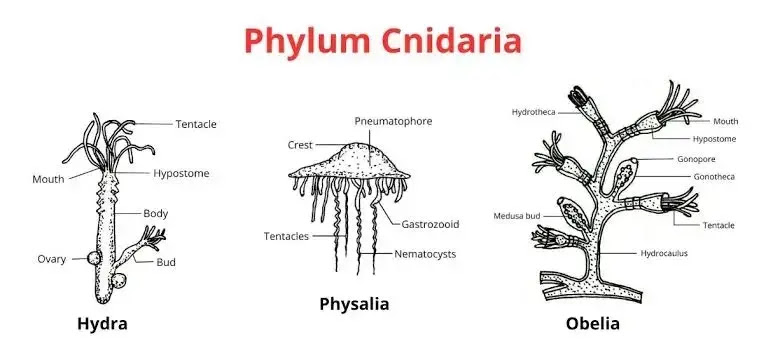 |
| Labelled diagram of Hydra, Physalia, and Obelia representing important examples of phylum Cnidaria. |
Introduction
In this post, you will learn about the characteristics of Cnidaria, body organization, habitat, symmetry, cnidocytes, reproduction, and important examples in a simple and exam-oriented way. Cnidaria is an important topic in Class 11 Biology, NEET preparation, practical exams, and viva questions.
Cnidarians are aquatic animals known for their stinging cells called cnidocytes. They are among the simplest multicellular animals with tissue-level organization.
Classification of Cnidaria
Kingdom: Animalia
Phylum: Cnidaria
Common examples:
Hydra
Obelia
Aurelia (Jellyfish)
Adamsia (Sea anemone)
Physalia
Pennatula
General Characteristics of Cnidaria
Habitat
Mostly marine animals
Some freshwater forms are also present, such as Hydra
They may be solitary or colonial
Level of Organization
Cnidarians show tissue-level organization.
They are more advanced than Porifera because true tissues are present.
Symmetry
Cnidarians show radial symmetry.
Body parts are arranged around a central axis.
Germ Layers
Cnidarians are diploblastic animals.
Two Germ Layers
Ectoderm
Endoderm
A non-cellular jelly-like layer called mesoglea is present between them.
Body Form
The body is sac-like and consists of:
Mouth
Tentacles
Gastrovascular cavity
The body has only one opening, which functions for both ingestion and egestion.
Cnidocytes and Nematocysts
Cnidarians possess specialized stinging cells called cnidocytes.
Each cnidocyte contains a nematocyst.
Functions of Cnidocytes
Capture prey
Defense
Attachment
Cnidocytes are the characteristic feature of phylum Cnidaria.
Gastrovascular Cavity
The internal cavity is called the gastrovascular cavity or coelenteron.
Functions
Digestion
Distribution of nutrients
Gas exchange
Digestion in Cnidaria
Cnidarians show holozoic nutrition.
Digestion occurs in two steps:
Extracellular digestion inside the gastrovascular cavity
Intracellular digestion inside cells
They mainly feed on small aquatic organisms.
Respiration and Excretion
Cnidarians do not possess specialized respiratory or excretory organs.
Respiration
Occurs through diffusion.
Excretion
Nitrogenous wastes diffuse out through the body surface.
Nervous System
Cnidarians possess a primitive nerve net.
Features
No brain
No central nervous system
Nerve cells distributed throughout the body
Polyp and Medusa Forms
Cnidarians commonly show two body forms.
Polyp Form
Cylindrical body
Sessile
Mouth directed upward
Example:
Hydra
Adamsia
Medusa Form
Umbrella-shaped body
Free-swimming
Mouth directed downward
Example:
Aurelia
Reproduction in Cnidaria
Cnidarians reproduce both asexually and sexually.
Asexual Reproduction
Occurs mainly by budding.
Sexual Reproduction
Occurs through formation of gametes.
Some cnidarians show alternation of generations called metagenesis.
Skeleton in Cnidaria
Some cnidarians possess external skeletons made of calcium carbonate.
Example:
Corals
Coral skeletons contribute to coral reef formation.
Coral Reefs
Coral reefs are large underwater structures formed by colonies of corals.
Importance of Coral Reefs
Provide habitat to marine organisms
Protect coastlines
Support marine biodiversity
Examples of Cnidaria
Hydra
Freshwater polyp
Shows regeneration
Obelia
Colonial cnidarian
Shows alternation of generations
Aurelia
Common jellyfish
Medusa dominant
Adamsia
Sea anemone
Sessile marine organism
Physalia
Commonly called Portuguese man-of-war
Colonial organism
Identification Features of Cnidaria
Aquatic habitat
Radial symmetry
Diploblastic body
Tissue-level organization
Presence of cnidocytes
Gastrovascular cavity
Single opening for ingestion and egestion
Difference Between Porifera and Cnidaria
| Feature | Porifera | Cnidaria |
|---|---|---|
| Level of organization | Cellular | Tissue |
| Symmetry | Mostly asymmetrical | Radial |
| Special cells | Choanocytes | Cnidocytes |
| Digestive cavity | Absent | Present |
| Nervous system | Absent | Primitive nerve net |
Importance of Cnidaria
Biological Importance
Important in evolution of tissue organization
Useful in marine ecology studies
Ecological Importance
Coral reefs support marine ecosystems
Maintain biodiversity
Why Cnidaria is Important for Exams
Frequently asked in Class 11 Biology
Important for NEET basics
Common viva topic
Diagram-based questions are common
Quick Revision Notes
Cnidaria are diploblastic animals.
Symmetry is radial.
Specialized stinging cells are called cnidocytes.
Digestion is both extracellular and intracellular.
Body cavity is called coelenteron.
Two body forms are polyp and medusa.
Example of freshwater cnidarian: Hydra.
Viva Questions
What is the characteristic feature of Cnidaria?
Answer: Presence of cnidocytes.
Explanation: Cnidocytes contain nematocysts used for stinging and prey capture.
What type of symmetry is found in cnidarians?
Answer: Radial symmetry.
Explanation: Body parts are arranged around a central axis.
What is mesoglea?
Answer: A jelly-like non-cellular layer between ectoderm and endoderm.
Explanation: It provides support and elasticity.
Name one freshwater cnidarian.
Answer: Hydra
Explanation: Hydra lives in freshwater ponds and streams.
MCQs on Cnidaria
Which cell is characteristic of Cnidaria?
(a) Choanocyte
(b) Amoebocyte
(c) Cnidocyte
(d) Flame cell
Answer: (c) Cnidocyte
Explanation: Cnidocytes are specialized stinging cells unique to cnidarians.
Cnidarians show which type of symmetry?
(a) Bilateral
(b) Asymmetrical
(c) Radial
(d) Spherical
Answer: (c) Radial
Explanation: Body parts are arranged around a central axis.
Which of the following is a freshwater cnidarian?
(a) Aurelia
(b) Adamsia
(c) Hydra
(d) Pennatula
Answer: (c) Hydra
Explanation: Hydra is a freshwater cnidarian.
The body cavity in cnidarians is called:
(a) Coelom
(b) Spongocoel
(c) Gastrovascular cavity
(d) Pseudocoel
Answer: (c) Gastrovascular cavity
Explanation: It helps in digestion and nutrient distribution.
Frequently Asked Questions (FAQs)
Are cnidarians diploblastic or triploblastic?
Cnidarians are diploblastic animals because their body develops from two germ layers.
What is the function of nematocysts?
Nematocysts help in prey capture and defense.
Which body form is free-swimming in cnidarians?
The medusa form is free-swimming.
Why are corals important?
Corals help in reef formation and support marine biodiversity.
Keywords
cnidaria characteristics, characteristics of cnidaria class 11, cnidaria notes for NEET, cnidaria examples, cnidocytes function, nematocysts in cnidaria, polyp and medusa difference, cnidaria diagram, gastrovascular cavity, diploblastic animals