Capacitors are electronic components that store electrical energy in an electric field between two conductive plates separated by a dielectric layer.
In this post, you will learn about capacitors, capacitance, the parallel plate capacitor derivation, the fringing effect, the dielectric effect, the dielectric constant, and key electrostatics formulas for Class 12 Physics.
Capacitors and capacitance are important topics in Class 12 Physics for CBSE and RBSE board exams. These concepts help in understanding charge storage, energy storage, and solving numerical problems based on electrostatics.
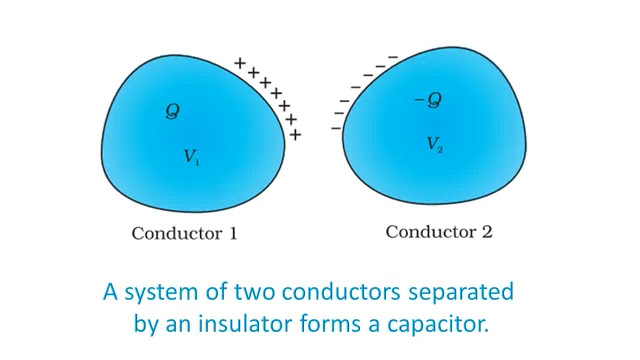
A capacitor is an electronic component that stores electrical energy in the form of an electric field. It consists of two conductive plates (two conductors) separated by a dielectric material such as air, vacuum, paper, or mica.
The two conductors carry equal and opposite charges `+ Q` and `- Q`, creating potentials `V_1` and `V_2`.
capacitor
In general, two conductors have charges + Q and – Q, with a potential difference `V = V_1 – V_2` between them.
Although a capacitor stores equal and opposite charges on its plates, the net charge of the capacitor as a whole remains zero.
When charge Q is given to an isolated conductor of any shape or size, it develops a potential V such that
or
`Q =C V`
`C =frac{Q}{V}`
Where Q is the charge stored, V is the applied voltage, and C is the capacitance.
Definition of Capacitance
Capacitance is the ability of a capacitor to store electric charge per unit potential difference.
Formula of Capacitance
`C = frac{Q}{V}`
Where
C = Capacitance
Q = Charge stored
V = Potential difference
The SI unit of capacitance is coulomb/volt, called farad (F).
Farad is a very large unit. In practice, microfarads and picofarads are commonly used.
Capacitance depends on
Shape and size of the conductor
Distance between conductors
Nature of the surrounding medium
The Parallel Plate Capacitor
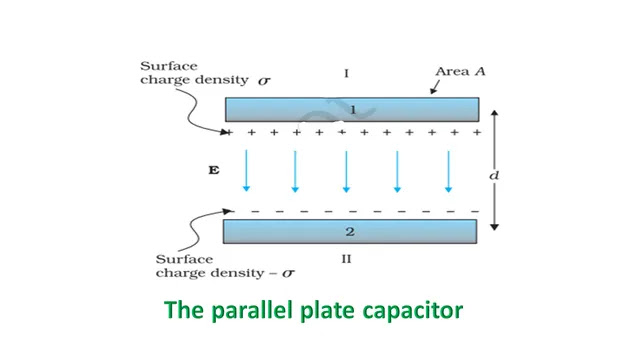
A parallel plate capacitor consists of two large conductive plates of area A separated by a small distance d.
The space between the plates may be filled with air, vacuum, or a dielectric material.
Fringing Effect
In an ideal case, when the plate area is much larger than the separation (A>>d), the electric field between the plates,
Nearly uniform
Perpendicular to the plates
Confined mostly between the plates
However, near the edges of the plates, the electric field lines slightly bend outward.
The bending of electric field lines near the edges is called the fringing effect.
Capacitance – Definition and Formula
Capacitance is a measure of a capacitor’s ability to store charge per unit voltage.
Formula of Capacitance
`C = frac{Q}{V}`
Where
Q = charge stored on the plates.
V = potential difference between the plates.
Derivation of the Capacitance of a Parallel Plate Capacitor
A parallel-plate capacitor consists of two conductive plates of area A, separated by a distance d, with a dielectric material (often air or vacuum) between them.
Electric Field Between Plates
The parallel plate capacitor
For an ideal infinite sheet of charge
`E = frac{sigma}{2 epsilon_0}`
Now consider two oppositely charged plates.
The electric fields due to both plates cancel each other at the outer region I (above the top plate)
Thus, the electric field between the plates of a parallel plate capacitor is uniform and directed from the positively charged plate toward the negatively charged plate.
Potential Difference Between Plates
For a uniform electric field
`E = frac{V}{d}`
Substituting the value E
`frac{V}{d}= frac{ Q}{ varepsilon_0 A}` `{because E = frac{V}{d}}`
`frac{V}{Q}= frac{d}{varepsilon_0 A}`
`frac{Q}{V}= frac{ varepsilon_0 A} { d}`
Since, `C = frac {Q}{V}`
Therefore,
`C =frac{varepsilon_0 A}{d}`
This is the formula for the capacitance of a parallel plate capacitor.
Final Formula:
Thus, the formula for the capacitance of a parallel plate capacitor is given by
`C =frac{ varepsilon_0 A}{d}`
Where
C = Capacitance
`varepsilon_0 `= permittivity of free space (approximately `8.85 times {10}^{- 12}` F/m),
A = Area of each plate and
d = distance between the plates.
Effect of Dielectric on Capacitance
When a vacuum or air is between the plates,
Electric Field
`E_0 =frac{ sigma}{ varepsilon_0}`
Potential difference `V_0 = E_0 d`
Capacitance
`C_0 =frac{Q}{V_0} = frac{ varepsilon_0 A}{d}`
When a dielectric is inserted between the plates, it fully occupies the intervening region. The dielectric is polarised by the field, and its effect is equivalent to two charged sheets (at the surface of the dielectric normal to the field) with surface charge densities `sigma_p` and `- sigma_p`.
The electric field inside the dielectric becomes
`E = frac{sigma – sigma_p}{varepsilon_0}`
The potential difference across the plates is
`V = E d = frac{sigma – sigma_p}{varepsilon_0}d `
For a linear dielectric, we expect `sigma_p` to be proportional to `E_0`, i.e., to `sigma`.
Thus, `sigma – sigma_p` is proportional to sigma and we can write
`sigma – sigma_p = frac{sigma}{K}`
Where K is the dielectric constant of the medium, and K>1. We then have
(3)If several slabs of dielectric constants `K_1,K_2,K_3, …….,K_n ` and respective thickness `t_1,t_2,t_3, …….,t_n` are placed in between the plates of a capacitor, the capacitance
Capacitors and capacitance are among the most important topics in electrostatics. Understanding concepts like electric field, dielectric effect, and derivation of formulas helps in solving both theoretical and numerical problems effectively. Regular practice and formula revision are key to scoring high marks in board exams.
Test Your Knowledge: Capacitors and Capacitance MCQs
Q.1 What is the SI unit of capacitance?
(a) Volt
(b) Coulomb
(c) Farad
(d) Ohm
Answer: (c) Capacitance is measured in farad (F), which is coulomb per volt.
Did You Know?
A 1 farad capacitor is extremely large – most practical capacitors are microfarads (`mu`F) or picofarads (pF).
Adding a dielectric material can increase capacitance without increasing charge.
The energy stored in a capacitor is given by: `U = 1/2 C V^2`.
Capacitors are used in mobile phones, power supplies, and flash cameras.
The human body can also act like a capacitor in certain situations!
Frequently Asked Questions (FAQs) – Capacitors and Capacitance