Complete Educational Solutions

Friday, 24 April 2026

Methods of Charging: Friction, Conduction & Induction | MCQs, Examples & FAQs


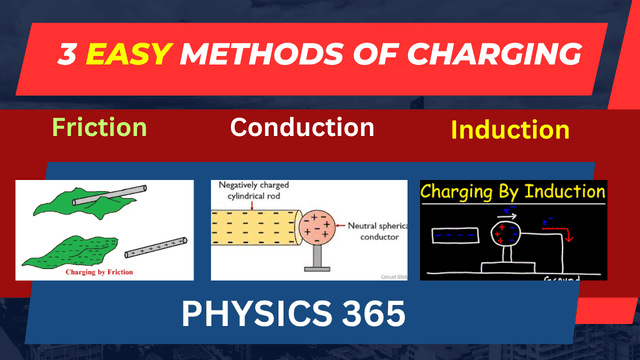
Three main methods of charging are friction, conduction, and induction.


    Charging is one of the most important topics in Class 12 Physics Electrostatics. Understanding the methods of charging (friction, conduction, and induction). These concepts are frequently asked in RBSE board exams and competitive tests. In this article, you will learn definitions, examples, and key concepts simply.

methods of charging class 12 physics friction conduction induction electrostatics diagram
Friction, Conduction, Induction Explained


What is Electric Charging?


    Electric charging is the process of transferring electrons from one body to another, resulting in an imbalance of electric charges.


  • Gain of electrons-Object becomes negatively charged

  • Loss of electrons-Object becomes positively charged


Methods of Charging


These methods are explained below:


(1)  Charging by Friction (Rubbing)


(2)  Charging by Conduction (Contact)


(3)  Charging by Induction


(1) Charging by Friction (Rubbing)


    When two objects are rubbed together, friction causes electrons to transfer between them. The object that loses electrons becomes positively charged, while the one that gains electrons becomes negatively charged.


For example


  • Rubbing a glass rod with silk makes the rod positive and the silk negative.

  • Ebonite, when rubbed with wool, becomes negatively charged.

  • Clouds also get charged by friction.

  • A comb moving through dry hair gets electrically charged. It starts attracting small bits of paper.

  • During landing or take-off, the tyres of an aircraft get electrified; therefore, special material is used to manufacture them.


Charging by Friction
Charging by Friction physics


    Since electrons have mass, the transfer of electrons during charging causes a slight change in the mass of a body.

    A.    Loss of electron - mass decreases slightly (positive charge).

    B.    Gain of electrons - mass increases slightly (negative charge).  

Key Point: The change in mass is extremely small and negligible in practical situations.

Transfer of Electrons:


    Charging of a body occurs due to the transfer of electrons from one material to another. Electrons are the only mobile charge carriers in most materials, so the movement of electrons is responsible for charging. Charging is mainly associated with static electricity (electrostatics).


Positive and Negative Charges:


  • When an object loses electrons, it becomes positively charged because the number of protons exceeds the number of electrons.

  • Example: Glass rod rubbed with silk.

  • When an object gains electrons, it becomes negatively charged due to the excess of electrons.

  • Example: Ebonite rod rubbed with fur.

Charging by Conduction | Class 12 Physics (RBSE)


(2) Charging By Conduction (Contact)


     Charging by Conduction is a method of charging in which a charged object transfers charge to a neutral object through direct contact. In simple terms, charging by conduction physics involves the transfer of electrons from one body to another. 


    If you are wondering what is charging by conduction, it is one of the most important concepts in the electrostatics class 12, especially for the RBSE board exams.

Charging by Conduction: Explanation with Example

    When a charged object is brought near a neutral object without touching it, charges are rearranged within the object.

  • When a negatively charged rod touches a neutral metal sphere, electrons transfer to the sphere, making it negatively charged.

  • If a positively charged object is used, electrons move from the neutral object to it, making the neutral object positively charged.

    These charging by conduction examples are frequently asked in exams and help understand charge transfer in conduction clearly.

How Does Charging by Conduction Work?

    We can simply explain the method of charging by conduction in a simple three-step process.

  • A charged object is brought into contact with a neutral conductor.

  • Electrons start transferring due to a potential difference.

  • The neutral object acquires the same type of charge as the charged object.


Key Features

  • Requires direct physical contact

  • Involves electric charge transfer

  • The object gets the same type of charge

  • Works mainly with conductors, not insulators.

Charging by Conduction 

These charging by conduction class 12 RBSE notes are useful for quick revision:

  • Definition: Transfer of charge by direct contact.

(3)    Charging by Induction (Without Contact)


    When a charged object is brought near a neutral object without touching it. Charges are rearranged with the object. This process is called charging by induction.

    In charging by induction physics, there is no direct contact between the object; instead, the presence of a charged body causes a separation of charges in the neutral object.

Charging by Induction: Explanation with Example

  • When a negatively charged rod is brought near a neutral metal sphere, electrons in the sphere move away from the rod.

  • If the sphere is grounded, excess electrons leave the sphere, and it becomes positively charged.

  • When the rod is removed, the sphere remains charged without ever touching the rod.


How Does Charging by Induction Work?

    We can simply explain the method of charging by Induction in a few simple steps.

  • A charged object is brought near a neutral conductor.

  • Charges inside the conductor rearrange due to the electrostatic force.

  • Grounding allows electrons to enter or leave the conductor.

  • After removing the ground and the charged object, the conductor remains charged.

Key Features

  • No physical contact is required. 

  • Involves rearrangement of charges.

  • Requires grounding for permanent charging.

  • The object gets the opposite type of charge.

Summary Table for Methods of Charging


Methods

Contact
     
 Charge Type

Example
Friction              Yes(Rubbing)         Opposite charge                  Balloon & Hair
Conduction   Yes (Touching)          Same charge                 Metal touch
Induction   No (Nearness)           Opposite charge         Charged rod near the conductor


Conclusion

    The types of charging friction, conduction, and induction are key concepts in Class 12 electrostatics. Understanding these methods helps you easily solve exam questions and connect physics with real-life examples.

Quick Revision: Methods of Charging


  • Charging is the process of transfer of electrons.

  • The three methods differ based on contact and charge transfer.

(A)    Friction - Rubbing causes charge transfer.

(B)    Conduction - Direct contact transfers charge.

(C)    Induction - No contact; charges rearrange due to a nearby body.

  • Charging by induction happens without contact, using the effect of a nearby charged object.

  • Like charges repel and unlike charges attract - this principle is key in all methods.

Real-Life Applications of Methods of Charging


    Understanding methods of charging in physics is not just theory - it explains many everyday phenomena and modern technologies around us.

  • Photocopiers & Laser Printer (Induction): These machines use an electrostatic charge to attract toner powder to paper, helping create clear, precise prints.

  • Electrostatic Spray Painting (Conduction/Induction): Car painting industries charge paint particles so they stick uniformly to surfaces, saving paint and giving a smooth, professional finish.

  • Lightning Formation (Induction): One of the most powerful natural examples! Charge buildup between clouds and the Earth leads to lightning via electrostatic induction.

  • Static Electricity in Clothes (Friction): Ever noticed clothes sticking together after drying? That is because friction causes charge buildup.

  • Touchscreens (Induction): Smartphones detect your touch because your finger disturbs the electric field on the screen.

  • Pollution Control (Electrostatic Precipitators): Industries use electrostatic charging to remove dust and harmful particles from smoke, helping reduce air pollution.

  • Everyday Electric Shocks (Conduction): When you touch a charged object and feel a small shock, it is due to charge transfer by conduction.


Did You Know? (Boost Your Understanding)


  • You get tiny shocks because of charging! When you touch a metal object after walking on carpet, it's due to charge buildup by friction.

  • A lightning bolt can reach temperatures hotter than the Sun's surface! It's caused by massive charge buildup through induction.

  • Photocopiers don't use ink directly: They rely on electrostatic charges to place toner exactly where needed.

  • Rubber shoes can prevent electric shocks because they stop the flow of charge to the ground.

  • Modern car painting saves paint using electrostatics, making it both cost-effective and eco-friendly.

  • Only electrons move in charging, not protons, which is why solids can easily get charged without changing their structure.

  • Fun Fact: Your Comb can attract small paper pieces after rubbing it on dry hair - a simple example of charging by friction.

Test Your Knowledge: Methods of Charging MCQs


1. Which process involves the transfer of charge between two objects by rubbing them together?

(A)    Conduction
(B)    Induction
(C)    Friction
(D)    Polarization


2. If a negatively charged rod is brought near a neutral metal sphere without touching it, what happens to the sphere?

(A)   It becomes negatively charged throughout.
(B)   It becomes positively charged throughout.
(C)   Its charges redistribute, but it remains net neutral.
(D)    It gains protons from the rod.


3. In charging by conduction, what is the nature of the final charge on the uncharged object?

(A)   Opposite to the charging object.
(B)   Same as the charging object.
(C)   It remains neutral.
(D)   It becomes twice as strong as the original charge.


4. What is required to give a neutral object a permanent charge via induction?

(A)   A vacuum
(B)   Constant
(C)   Grounding (Earthing)
(D)   An insulator


5. A neutral metal sphere is charged by induction using a negatively charged rod. During the process, the sphere is grounded. What is the final charge on the sphere after removing the grounded and then the rod?

(A)   Negative
(B)   Positive
(C)   Neutral
(D)   Depends on distance


6. Two identical conducting spheres Q and B carry charges +4 `\mu`C and - 2 `\mu`C, respectively. They are brought into contact and then separated. What is the final charge on each sphere?

(A)   + 1 `\mu`C
(B)   + 2 `\mu`C
(C)   - 1 `\mu`C
(D)   0 `\mu`C


7.A charged glass rod attracts small bits of paper. This phenomenon is best explained by:

(A)   Charging by conduction
(B)   Charging by induction
(C)   Polarisation of molecules
(D)   Transfer of protons


8. A conductor is charged positively by induction. Which of the following statements is correct?

(A)   Electrons are added to the conductor
(B)   Protons are removed from the conductor
(C)   Electrons are removed from the conductor
(D)   Neutrons are transferred


9. A negatively charged rod is brought near an isolated conductor. Which statement is correct?

(A)   The conductor becomes negatively charged
(B)   The conductor becomes positively charged
(C)   The near end becomes positive and the far end negative
(D)   The near end becomes negative and the far end positive

Frequently Asked Questions (FAQs) - Methods of Charging


Q.   What are the different methods of charging?

Q.   What is charging by friction?

Q.   What is charging by conduction?

Q.   Which method of charging does not require contact?

Q.   What type of charge is produced in friction?

Q.   What happens to electrons during charging?

Q.   Why does a charged object attract a neutral object?

Q.   Can a conductor be charged by induction?

Q.   Which method is commonly seen in daily life?

Q.   What is the SI unit of electric charge?


Call to Action

    Now you have all the essential information on methods of charging in physics, and we hope this guide has helped you clearly understand the concept. If you have any doubts, feel free to drop your queries in the comment section - we are always here to help. For more Class 12 Physics notes, MCQs, quick revision content, and concept-based learning, visit Physics365 and check out our YouTube channel Physics365. Don't forget to subscribe for regular updates and to boost your knowledge, and if you want well-structured study material, you can also buy our premium PDF notes for better exam preparation. ** Learn smarter, score higher**

    No comments:

    Post a Comment