Electric field lines are imaginary continuous curves drawn in an electric field such that the tangent at any point gives the direction of the electric field, while the density of lines represents the field strength.
In this post, you will learn about electric field lines class 12, including the properties of electric field lines, their definition, key properties, diagrams for different charge configurations, and important concepts that are frequently asked in Class 12 board exams, JEE, and NEET. This guide will help you understand the topic clearly and revise it quickly. These electric field lines class 12 notes help in quick revision.
What are Electric Field Lines in class 12 Physics?
Definition of Electric Field Lines
Electric field lines are imaginary paths that represent both the direction and strength of the electric field.
Key Properties of Electric Field Lines (Class 12 Physics)
Direction
They start from positive charges and end at negative charges.
Tangent Rule
The tangent drawn to an electric field line at any point gives the direction of the electric field at that point.
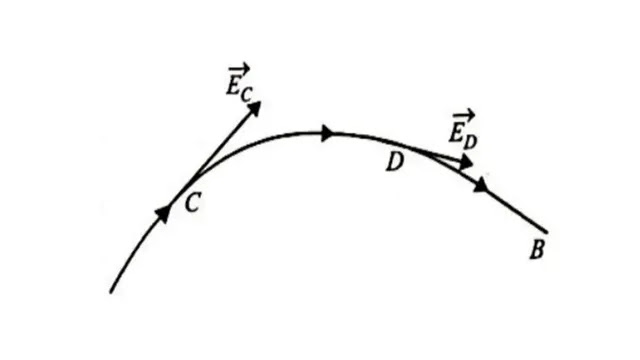 |
| Direction of Electric Field |
Non-Intersection
Two electric field lines never cross each other; if they did, there would be two directions for the electric field at that point, which is physically impossible.
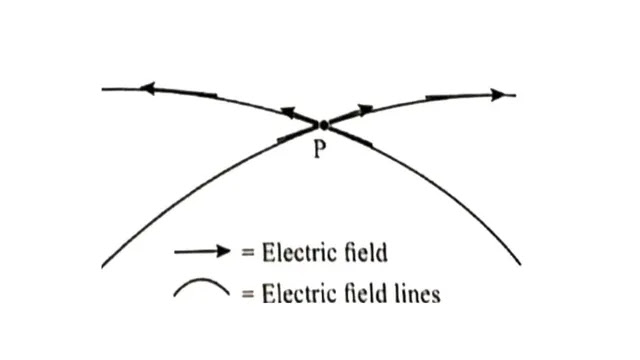 |
| field lines never intersect |
Relation with Conductors
Electric field lines are perpendicular to the conductor in electrostatic equilibrium because the tangential component of the electric field inside a conductor is zero.
Field Strength
The closeness or density of field lines represents the strength of the electric field; closer lines mean a stronger field, while widely spaced lines mean a weaker field.
Equipotential Surfaces
Field lines are always perpendicular to Equipotential surfaces.
No Closed Loops
Electric field lines never from closed loops because electrostatic fields are conservative in nature.
For a single positive charge
Electric field lines around a positive charge are directed radially outward, diverging away from the charge.
For a single negative charge
Electric field lines around a negative charge are directed radially inward, converging toward the charge.
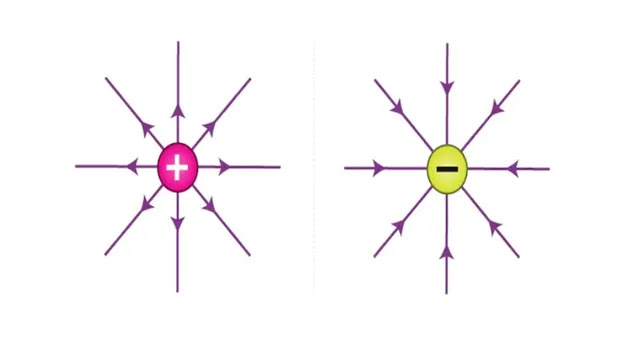 |
| electric-field-lines-diagram.png |
For an electric dipole
In an electric dipole, electric field lines originate from the positive charge and terminate on the negative charge.
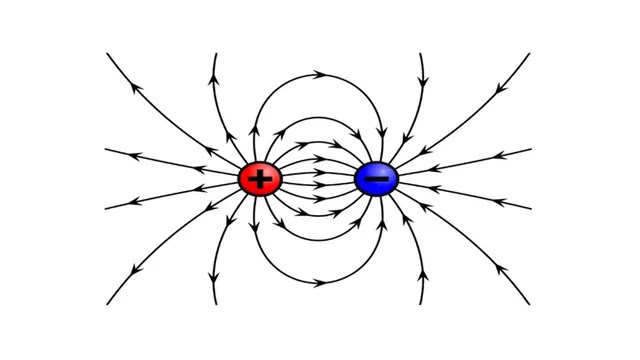 |
| Electric field lines between opposite charges (dipole pattern) |
Uniform Electric Field:
If electric field lines are equally spaced, the field is uniform.
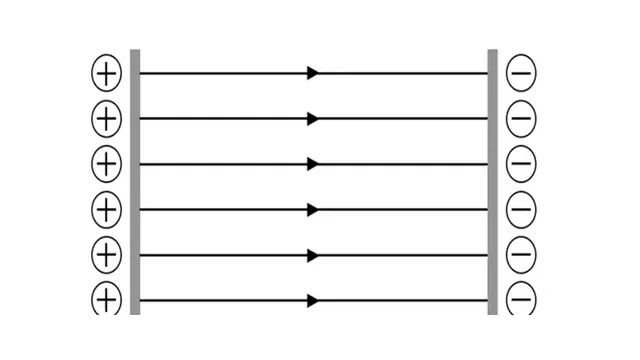 |
| Uniform electric field diagram |
Properties of Electric Field Lines
- The electric field inside a conductor is zero; field lines do not exist inside it.
- Electric field lines become denser between opposite charges because the electric field is stronger in that region.
- Electric field lines provide a visual representation of the electric field, making it easier to understand the behavior of charges and field distribution in electrostatics.
Real Life Applications
- Lightning (Natural Electric Field)
- Capacitors (Electronics & Circuits)
- Electrostatic Shielding (Faraday Cage)
- Photocopiers & Laser Printers
- Electrostatic Precipitators (Pollution Control)
Electric field lines are not just theoretical – they help us understand and design real-world technologies from lightning protection to modern electronics.
Conclusion
In conclusion, electric field lines are a simple and effective way to visualize the behavior of an electric field around charges. Their properties – such as direction from positive to negative, density representing field strength, non-intersection, and perpendicular nature to conductors – help explain key electrostatic concepts. Beyond theory, they play an important role in real-world applications like capacitors, lightning protection, and electronic devices. Mastering electric field lines strengthens understanding of electrostatics and helps in board exams and competitive exams like JEE and NEET.
Test Your Knowledge: Electric Field Lines, MCQs
Q. Electric field lines originate from and terminate on which charges?
(a) Negative to positive
(b) Positive to negative
(c) Only from positive
(d) Only on negative
Answer: (b)
Explanation: Electric field lines start from positive charges and end at negative charges, showing the direction of the electric field.
Q. What does the closeness of electric field lines represent?
(a) Direction of field
(b) Nature of charge
(c) Strength of the electric field
(d) Potential difference
Answer: (c)
Explanation: Closer field lines indicate a stronger electric field, while wider spacing indicates a weaker field.
Q. Why do electric field lines never intersect?
(a) They repel each other
(b) They are imaginary
(c) Two directions at one point are impossible
(d) Charges are fixed
Answer: (c)
Explanation: If field lines intersected, the electric field would have two directions at the same point, which is not physically possible.
Q. How are electric field lines oriented with respect to a conductor in electrostatic equilibrium?
(a) Parallel to the surface
(b) Inclined at any angle
(c) Perpendicular to the surface
(d) Circular around the surface
Answer: (c)
Explanation: Electric field lines are perpendicular to the conductor’s surface to ensure no tangential force acts on charges.
Key Characteristics & Rules (Quick Review)
Direction: Start at a positive (+) charge, end at negative (-) charges.
No Intersection: Two lines never cross; otherwise, it would imply two directions for the field at that point.
Density: Crowded lines indicate a strong field (E); sparse lines indicate a weak field.
Tangents: The tangents to a line at any point gives the direction of the electric field `(vec E)`.
Conductors: Field lines are always perpendicular to the surface of a conductor.
Loops: They do not form closed loops (unlike magnetic lines).
Isolation: For a single positive charge, lines go to infinity; for a single negative charge, they come from infinity.
Uniform Field: parallel, straight, and equally spaced lines indicate a uniform electric field.
Number of Lines: The number of lines is proportional to the magnitude of the charge.
Physical Significance
1. Force Path
A unit positive charge placed in the field would follow these lines.
2. Lateral Pressure
Lines exert lateral pressure, representing repulsion between like charges.
3. Longitudinal Contraction
Lines contract longitudinally between opposite charges, representing attraction.
Frequently Asked Questions (FAQs) – Electric Field Lines
Q. What is the definition of electric field lines?
Q. Why do electric field lines never intersect in electrostatics?
Q. What does the density of field lines represent?
Q. Why are electric field lines perpendicular to a conductor?
Q. Do electric field lines exist inside a conductor?
Call to Action (CTA)
If you found this post helpful, don’t stop here-take your preparation to the next level with structured resources and guided learning.
- Join Physics365 WhatsApp-Get daily questions & updates. Join Now
👉Don’t just read, start practicing and boost your score today!