In this post, you will learn about drift velocity, the random motion of electrons, the derivation of conductivity, current density, and the relation between electrical conductivity and Ohm’s law. This topic is very important for Class 12 Physics and competitive examinations.
Random Motion of Electrons
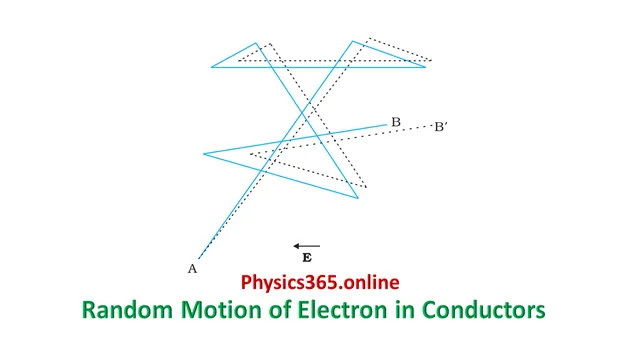 |
| Random Motion of Free Electrons in a Conductor. |
A conductor contains a large number of free electrons. These electrons are in continuous random motion due to thermal energy and frequently collide with the heavy fixed positive ions of the lattice. After each collision, the electrons again move in directions with different velocities.
Average Velocity of Free Electrons
In the absence of an external electric field, the random motion of free electrons is equally probable in all directions. Therefore, the average velocity of free electrons inside the conductor is zero.
Drift Velocity Derivation
When an electric field is applied across a conductor, free electrons experience a force and accelerate opposite to the direction of the electric field.
Force on an Electron in an Electric Field
We know that
…………….eq. (1)
The force acting on an electron in an electric field is
…………….eq. (2)
From equations (1) and (2)
Acceleration of an Electron
The negative sign indicates that the acceleration of electrons is opposite to the direction of the electric field.
Therefore, the magnitude of the drift velocity is
Where,
E = electric field intensity
m = mass of the electron
= relaxation time (average time between successive collisions)
= drift velocity
Meaning of Drift Velocity
In a conductor, free electrons continuously collide with the lattice ions. Although electrons accelerate between collisions, their average velocity in a particular direction becomes constant in the presence of an electric field. This constant average velocity is called drift velocity.
First Equation of Motion
According to the first equation of motion,
v = u + a t
Since the average random velocity of free electrons immediately after a collision is taken as zero,
u = 0.
Also,
Using the first equation of motion,
The negative sign shows that electrons drift opposite to the direction of the electric field. Therefore, the magnitude of the drift velocity is
Where,
e = Charge on the electron.
E = Intensity of electric field.
= Relaxation time (the average time between successive collisions).
= Drift velocity.
u = 0 ( velocity immediately after the last collision).
v = velocity at time t.
Derivation of Drift Velocity Formula
In a conductor, free electrons attain a constant average drift velocity in the presence of an electric field, although they are continuously accelerated between collisions. This constant average velocity is called the drift velocity.
Conductivity of a Conductor Formula Derivation
Consider a cylindrical conductor of length l and cross-sectional area A in an electric field E.
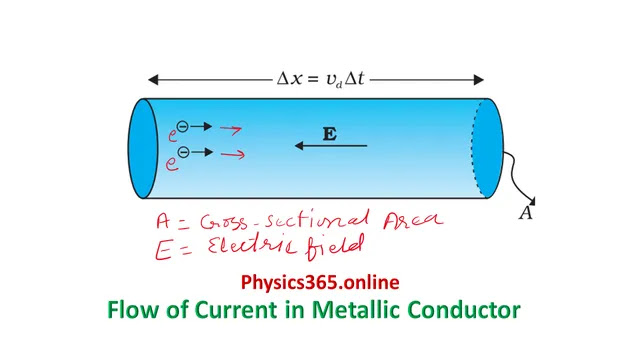 |
| Flow of Current in a Metallic Conductor |
If n is the number of free electrons per unit volume in the conductor, then the number of free electrons crossing area A in time `Delta t` is.
Then
In time `Delta t`, electrons drift through a distance
Therefore, the volume swept is
Therefore, the total charge crossing area A in time `Delta t` is
Total charge transported across this area A in the direction of the electric field
Since
therefore,
Dividing both sides by A
where J is current density.
In vector form
`vec {J} = frac {n e^2 tau }{m} vec E`
Comparing this question with the microscopic form of Ohm’s law,
because:
`vec J = sigma vec E`
It is called the microscopic form of Ohm’s law.
Here,
`sigma = frac {n e^2 tau }{m}`
Where,
`sigma =` conductivity of the conductor
This derivation leads to Ohm’s law under the assumption that `tau` and n remain constant and are independent of the electric field.
Relation Between Conductivity and Resistivity
`sigma = frac{1}{rho}`
Conductivity is the reciprocal of resistivity.
Conclusion
- Free electrons in a conductor move randomly due to thermal energy, resulting in zero average velocity.
- When an electric field is applied, electrons accelerate, creating a net drift velocity (`v_d`).
- The drift velocity formula is `v_d = frac{e E tau}{m}`.
- This results in the current density `J = frac{n e^2 tau}{m} E`
- Conductivity (`sigma`) is given by `sigma = frac{n e^2 tau}{m} `
- Electrical conduction follows Ohm’s law when `tau` and `n` are constant.