Plant Cell and Animal Cell Difference | Class 10 Science Notes
 |
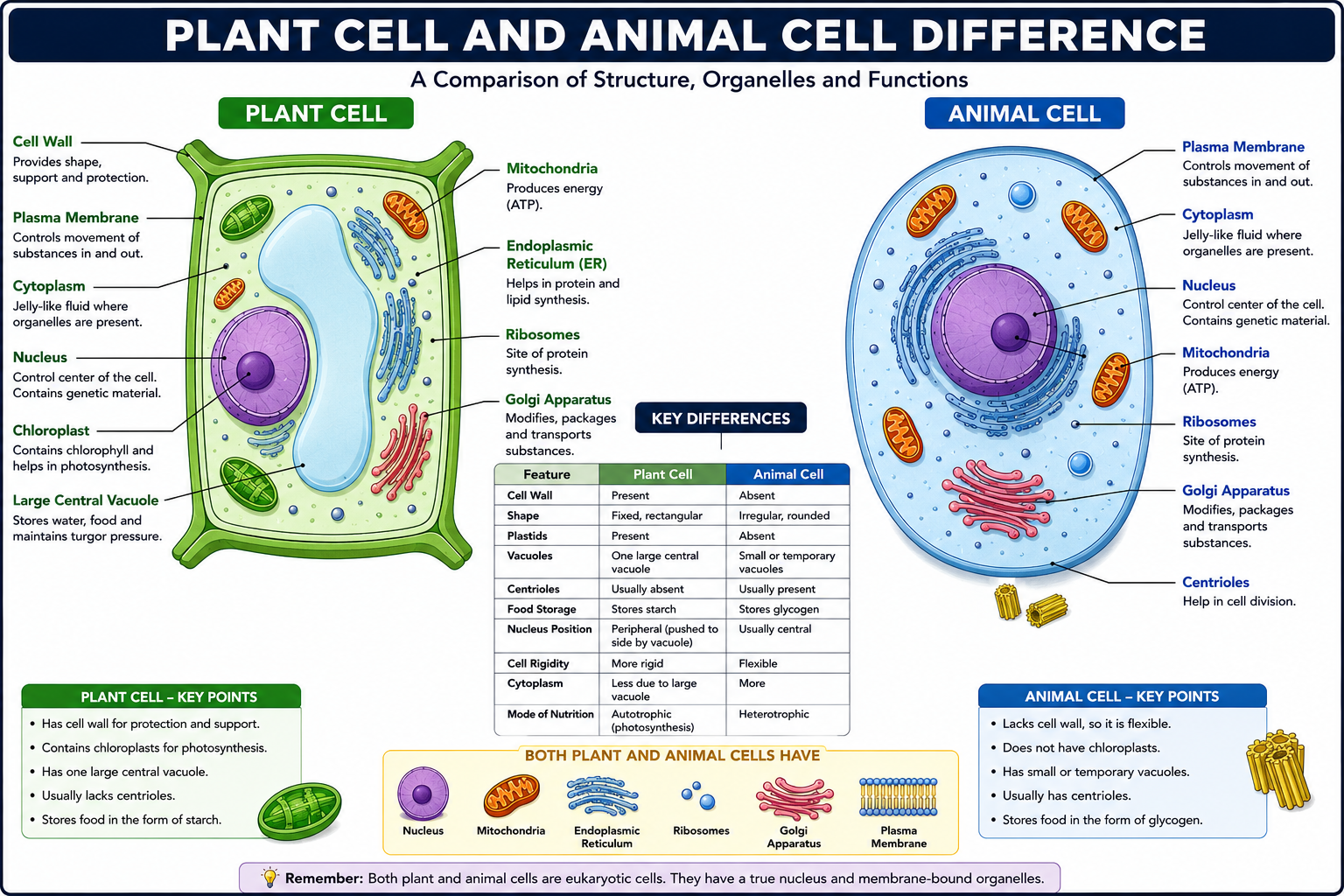
| Detailed comparison diagram of plant cell and animal cell showing major organelles, structural differences, and functions for Class 10 Science and NEET foundation preparation. |
Introduction
In this post, you will learn about the difference between plant cells and animal cells, including their structure, cell organelles, functions, and important comparison points in a simple and exam-oriented way. This topic is important for Class 10 Science, foundation biology, board exams, NEET preparation, practical exams, and viva questions.
Plant cells and animal cells are both eukaryotic cells because they possess a true nucleus and membrane-bound organelles. However, they differ in structure, shape, organelles, and functions according to the needs of plants and animals.
What is a Plant Cell?
A plant cell is a eukaryotic cell present in plants. It contains a rigid cell wall, plastids, and a large central vacuole.
Plant cells are usually fixed or rectangular in shape because of the presence of the cell wall.
What is an Animal Cell?
An animal cell is a eukaryotic cell present in animals. It lacks a cell wall and plastids.
Animal cells are generally irregular or rounded in shape and are more flexible than plant cells.
Similarities Between Plant Cell and Animal Cell
Both plant and animal cells have several common structures because both are eukaryotic cells.
Common Features
Plasma membrane present
Cytoplasm present
True nucleus present
Mitochondria present
Endoplasmic reticulum present
Golgi apparatus present
Ribosomes present
These organelles perform essential life processes in both types of cells.
Difference Between Plant Cell and Animal Cell
| Feature | Plant Cell | Animal Cell |
|---|---|---|
| Cell Wall | Present | Absent |
| Shape | Fixed and rectangular | Irregular or rounded |
| Plastids | Present | Absent |
| Vacuoles | One large central vacuole | Small or temporary vacuoles |
| Centrioles | Usually absent | Present |
| Food Storage | Stores starch | Stores glycogen |
| Nucleus Position | Peripheral due to large vacuole | Usually central |
| Rigidity | More rigid | Flexible |
Structure of Plant Cell
Plant cells contain several important structures that help plants perform photosynthesis and maintain rigidity.
Main Parts of Plant Cell
Cell Wall
The cell wall is a rigid outer covering mainly made of cellulose.
Functions
Provides support
Gives shape
Prevents bursting
Plasma Membrane
Present inside the cell wall.
Functions
Controls movement of substances
Protects internal organelles
Chloroplast
Chloroplasts contain chlorophyll.
Functions
Perform photosynthesis
Prepare food for plants
Large Vacuole
Plant cells contain a large central vacuole filled with cell sap.
Functions
Storage of water and substances
Maintains turgor pressure
Structure of Animal Cell
Animal cells contain most organelles found in plant cells except cell wall and plastids.
Main Parts of Animal Cell
Plasma Membrane
Forms the outer boundary of the cell.
Functions
Protection
Regulation of substances
Nucleus
Controls all cellular activities.
Functions
Stores genetic material
Controls growth and reproduction
Mitochondria
Called the powerhouse of the cell.
Functions
Produce ATP
Carry out respiration
Centrioles
Present near the nucleus in animal cells.
Functions
Help in cell division
Why Plant Cells Have Cell Wall?
Plants are stationary organisms and require additional support and rigidity.
The cell wall:
Maintains shape
Protects cells
Prevents bursting due to water intake
Why Animal Cells Lack Cell Wall?
Animals require flexibility and movement.
Absence of cell wall:
Allows movement
Helps cells change shape
Makes tissues flexible
Functions of Plant Cell and Animal Cell
Functions of a Plant Cell
Photosynthesis
Storage of food
Structural support
Functions of an Animal Cell
Movement
Energy production
Growth and repair
Importance of Studying Plant and Animal Cells
Understanding plant and animal cells helps students learn:
Basic organization of living organisms
Functions of organelles
Differences between plants and animals
Foundation concepts for advanced biology
Identification Features
Plant Cell
Cell wall present
Chloroplast present
Large vacuole
Fixed shape
Animal Cell
No cell wall
No chloroplast
Small vacuoles
Flexible shape
Why This Topic is Important for Exams
Frequently asked in Class 10 Science exams
Important for NEET foundation preparation
Diagram-based questions are common
Difference tables are often asked in exams
Quick Revision Notes
Plant cells contain a cell wall and chloroplasts.
Animal cells lack a cell wall and plastids.
Plant cells have large vacuoles.
Animal cells usually contain centrioles.
- The chloroplast performs photosynthesis.
Both cells possess a nucleus and mitochondria.
Viva Questions
Why do plant cells have a cell wall?
Answer: To provide support and protection.
Explanation: The rigid cell wall helps maintain shape and prevents bursting.
Which organelle performs photosynthesis?
Answer: Chloroplast
Explanation: A chloroplast contains chlorophyll required for photosynthesis.
Why are animal cells flexible?
Answer: Because they lack a rigid cell wall.
Explanation: Flexibility helps in movement and shape changes.
Which cell usually contains a large vacuole?
Answer: Plant cell
Explanation: The large vacuole stores cell sap and maintains turgor pressure.
MCQs on Plant Cell and Animal Cell Difference
Which structure is present only in plant cells?
(a) Nucleus
(b) Cytoplasm
(c) Cell wall
(d) Mitochondria
Answer: (c) Cell wall
Explanation: The cell wall is characteristic of plant cells.
Which organelle performs photosynthesis?
(a) Ribosome
(b) Mitochondria
(c) Chloroplast
(d) Golgi apparatus
Answer: (c) Chloroplast
Explanation: A chloroplast contains chlorophyll for photosynthesis.
Animal cells usually possess:
(a) Cell wall
(b) Plastids
(c) Centrioles
(d) Large vacuole
Answer: (c) Centrioles
Explanation: Centrioles help in cell division.
Plant cells are generally:
(a) Irregular
(b) Round
(c) Fixed in shape
(d) Amoeboid
Answer: (c) Fixed in shape
Explanation: The rigid cell wall gives a fixed shape.
Frequently Asked Questions (FAQs)
What is the main difference between a plant cell and an animal cell?
Plant cells possess a cell wall and chloroplasts, while animal cells do not.
Which cell contains a chloroplast?
Plant cells contain chloroplasts for photosynthesis.
Why is the vacuole larger in plant cells?
Large vacuoles help store water and maintain turgor pressure.
Are both plant and animal cells eukaryotic?
Yes, both possess a true nucleus and membrane-bound organelles.
Suggested Diagrams
Plant cell labelled diagram
Animal cell labelled diagram
Plant cell vs animal cell comparison diagram
Chloroplast structure diagram
These diagrams improve understanding and exam preparation.
Keywords
plant cell and animal cell difference, difference between plant cell and animal cell, plant vs animal cell class 10, plant cell diagram, animal cell diagram, cell organelles and functions, class 10 science notes, chloroplast function, plant and animal cell comparison, biology notes class 10