In this post, you will learn about Gauss’s Law, its mathematical form and physical meaning, and its powerful application for finding the electric field due to a charged hollow conducting sphere. This concept is extremely important for Class 12 Physics and competitive exams because it simplifies complex electric field calculations using symmetry.
Gauss’s law
Statement of Gauss’s Law
The total electric flux passing through a closed surface in vacuum (or air) is equal to the net charge enclosed divided by the permittivity of free space.
Mathematical Form of Gauss’s Law
`phi = frac{Sigma q}{epsilon_0}` ……eq.(1)
Where:
`Sigma q ` is the algebraic sum of charges enclosed within the surface.
`epsilon_0` is the permittivity of free space.
We know that
`frac{1}{4 pi epsilon_0} = K`
`frac{1}{ epsilon_0} = 4 pi K`
then from Equation 1
`phi = frac{1}{epsilon_0}times Sigma q`
`phi = 4 pi K times Sigma q`
This law is valid for all closed surfaces, regardless of their shape or size.
Concept of Electric Flux
Definition of Electric Flux
Electric flux represents the number of electric field lines passing through a surface. It depends on the electric field strength, surface area, and the angle between them.
Formula
`phi = oint vecE.dvec A`
Electric Field due to a Hollow Conducting Sphere
Let a conducting sphere be of radius R with center O. The conducting sphere carries a total charge q, which is uniformly distributed over its surface.
We aim to determine the electric field intensity at a point P, located at a distance r from the center O.
To calculate the electric field, we consider an imaginary spherical surface of radius r passing through point P. This surface is called a Gaussian surface.
At point P, consider a very small area element dA on the Gaussian surface. The direction of dA is radially outward along OP. Since the charge distribution is spherically symmetric, the electric field at point P is also directed along OP. Therefore, the electric field `vec E` and the area element `dvecA` are parallel at every point on the Gaussian surface.
Regions for Electric Field Calculation
We can find the intensity of the electric field at three different points
1. Electric field outside a spherical shell (r > R)
2. Electric field on the surface of a spherical shell (r = R)
3. Electric field inside a spherical shell (r < R)
Electric field outside a spherical shell (r>R)
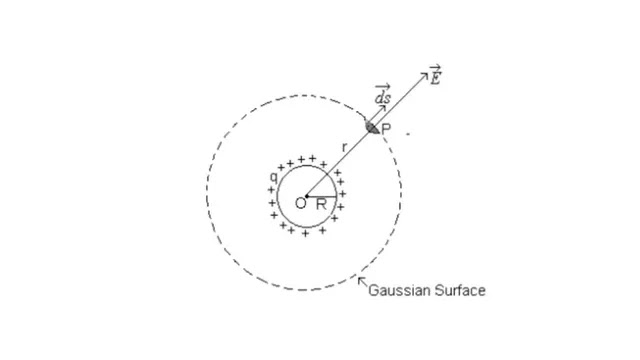 |
| Electric Field due to Hollow Sphere |
`phi = oint_s vec { E}.dvec {A}` `(dA = dS = text{area})`
`phi = oint_s E dA cos theta`
Since the electric field and area vector are in the same direction, `(theta = 0^{circ})`
`phi = oint_s E dA cos 0`
`phi = oint_s E dA` `(because cos 0 = 1)`
Because E remains constant over the spherical Gaussian surface,
`phi = E oint_s dA`
`phi = E A` `(because oint dA = A)`
`phi = E times 4pi r^2` ….Eq. (1) `(because A = 4pi r^2)`
According to Gauss’s law
`phi = frac{q}{epsilon_0}` ….Eq. (2)
Equate equations 1 and 2
`E times 4pi r^2` = `frac{q}{epsilon_0}`
`E_{text{out}}` = `frac{q}{4 pi epsilon_0 r^2}`
Therefore,
`E_{text{out}}` = `frac{1}{4 pi epsilon_0}frac{q}{r^2}`
`E_{text{out}}` = `frac{K q}{r^2}`
In vector form
`vec E` = `frac{K q}{r^2}hat r`
Electric field on the surface of a spherical shell (r = R)
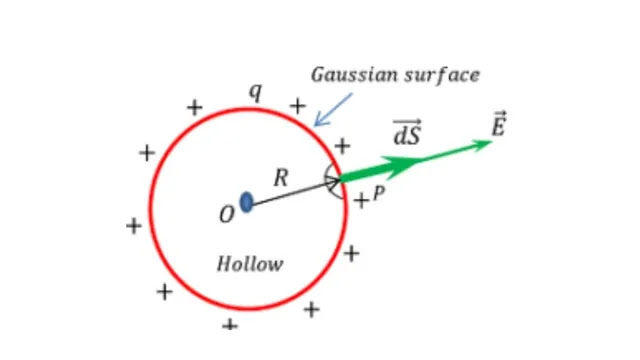 |
| Electric field on the surface of a spherical shell |
Hence,
`E_{text{surface}}` = `frac{K q}{R^2}` (Maximum Possible Value)
Electric field inside a spherical shell (r < R)
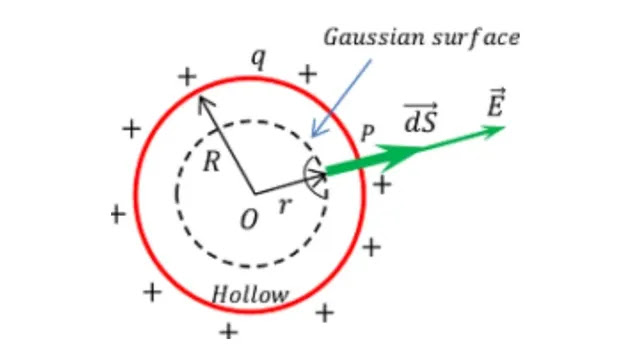 |
| Electric field on the surface of a spherical shell |
In a conducting sphere, free charges remain on the outer surface. Therefore, the net charge enclosed inside a Gaussian surface taken within the conductor is zero, so the electric field inside the conducting sphere is zero.
`E_{text{inside}} = 0`
Therefore, the electric field intensity inside a hollow conducting sphere is zero everywhere.
Graph between Electric Field and Distance
1. Outside the Sphere `(r > R)`
`E_{text{out}}` = `frac{K q}{r^2}`
`E prop frac{1}{r^2}`
Thus, the electric field decreases inversely with the square of the distance.
2. On the Surface `(r = R)`
`E_{text{surface}}` = `frac{K q}{R^2}`
E = Constant (Maximum possible value)
The electric field is maximum at the surface.
3. Inside the Sphere `(r < R)`
`E_{text{inside}} = 0`
The electric field remains zero throughout the interior of the conducting sphere.
4. At the Center of Sphere
`E_{text{center}} = 0`
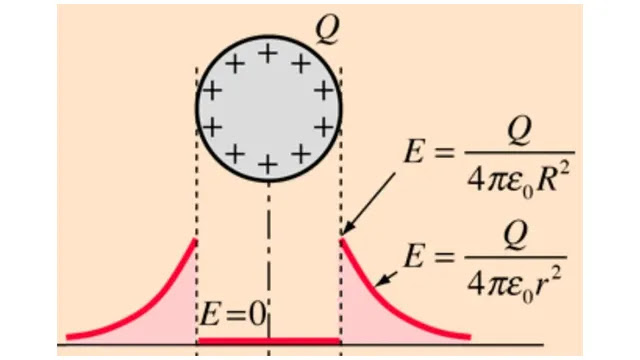 |
| Graph between Electric Field and Distance |
Conclusion
Electric Field due to Hollow Sphere MCQs
1. The electric field intensity at a point outside a spherical shell is given by:
a) E = Kq/r²
b) E = Kq/R²
c) E = Kq/r
d) E = Kq/R
2. Inside a conducting sphere, the electric field intensity is:
a) E = Kq/r²
b) E = Kq/R²
c) E = 0
d) E = 1/ε₀
3. The variation of the electric field intensity with distance outside a spherical shell follows which relationship?
a) E ∝ 1/r
b) E ∝ r
c) E ∝ 1/r²
d) E ∝ r²
4. According to Gauss’s law, the electric flux through a closed surface is directly proportional to:
a) Net charge enclosed
b) Inverse of net charge
c) Square of net charge
d) Inverse square of net charge
5. In the expression for electric flux, dA represents:
a) Electric field
b) Electric potential
c) Electric charge
d) Area element
6. The electric field intensity at the centre of a conducting sphere is:
a) E = Kq/r²
b) E = Kq/R²
c) E = 0
d) E = 1/ε₀
Answers:
1. a) E = Kq/r²
2. c) E = 0
3. c) E ∝ 1/r²
4. a) Net charge enclosed
5. d) Area element
6. c) E = 0
Short Answer type Question
1. What is Gauss’s law?
Answer: Gauss’s law states that the total electric flux passing through a closed surface equals the net charge enclosed divided by the permittivity of free space.
2. What is the mathematical expression for Gauss’s law?
Answer: `phi = frac{Sigma q}{epsilon_0}`
3. What is the relationship between `epsilon_0` and `K`?
Answer:`epsilon_0` and K is: `frac{1}{epsilon_0} = 4 pi K`.
4. How can the total electric flux be calculated using Gauss’s law?
Answer: The total electric flux can be calculated using the formula: `phi = 4 pi K times Sigma q`.
5. What is the direction of the electric field and the area element on the Gaussian Surface?
Answer: The electric field and the area element are in the same direction on the Gaussian Surface.
6. What are the three different points for which the intensity of the electric field is calculated?
Answer: The electric field is calculated in three regions: outside a spherical shell, on the surface of a spherical shell, and inside a spherical shell.
7. What is the expression for the electric field outside a spherical shell?
Answer: The expression for the electric field outside a spherical shell is: `E_{text{out}} = frac{Kq}{r^2}`, where `r` is the distance from the center of the shell.
8. What is the expression for the electric field on the surface of a spherical shell?
Answer: The expression for the electric field on the surface of a spherical shell is: `E_{text{surface}} = frac{Kq}{R^2}`, where `R` is the radius of the shell.
9. What is the electric field inside a spherical shell?
Answer: The electric field inside a spherical shell is zero.
10. What is the relationship between electric field and distance outside a spherical shell?
Answer: The relationship between electric field and distance outside a spherical shell is: `E propto frac{1}{r^2}`.
11. What is the maximum possible value of the electric field on the surface of a spherical shell?
Answer: The maximum possible value of the electric field on the surface of a spherical shell is given by `E_{text{surface}} = frac{K q}{R^2}`.
12. What is a Gaussian surface?
Answer: A Gaussian surface is an imaginary closed surface used to apply Gauss’s law for calculating electric fields.
13. What is the graph between the electric field and the distance outside a spherical shell?
Answer: The graph between electric field and distance outside a spherical shell shows an inverse square relationship: `E propto frac{1}{r^2}`.
14. What is the electric field at the center of a conducting sphere?
Answer: The electric field at the center of a conducting sphere is zero.
15. What is the net charge enclosed inside a Gaussian surface taken within a conductor?
Answer: The net charge enclosed is zero.
Numerical Question
1. A conducting sphere of radius 5 cm carries a charge of 8 μC. What is the electric field at a point located 10 cm away from the center of the sphere? (Answer: `7.2 times 10^6` N/C)
2. A conducting sphere with a charge of -4 nC is surrounded by a concentric Gaussian surface of radius 12 cm. Calculate the electric field at this surface. (Answer: E ≈ 2.5 x `10^3` N/C toward the sphere)
3. A conducting sphere has a charge of 10 μC. Determine the electric field at a point 15 cm away from the center of the sphere. (Answer: `4 times 10^6` N/C)
4. The electric field at a distance of 6 cm from the center of a conducting sphere is 12 kN/C. What is the charge on the sphere? (Answer: 4.8 nC)
5. A conducting sphere with a charge of -2 μC is enclosed by a Gaussian surface of radius 8 cm. Calculate the electric field at this surface. (Answer: “2.81 times 10^6 text{N/C}` toward the sphere)
6. The electric field at a distance of 4 cm from the center of a conducting sphere is 9 kN/C. Determine the charge on the sphere. (Answer: 1.6 nC)
7. A conducting sphere of radius 6 cm has a charge of 12 μC. Calculate the electric field at a point located 12 cm away from the center of the sphere. (Answer: `7.5 times 10^6` N/C)
8. A conducting sphere with a charge of -6 nC is surrounded by a Gaussian surface of radius 10 cm. Find the electric field at this surface. (Answer: `5.4 times 10^3 text {N/C}` toward the sphere)
9. The electric field at a distance of 8 cm from the center of a conducting sphere is 18 kN/C. Determine the charge on the sphere. (Answer: 12.8 nC)
10. A conducting sphere of radius 4 cm carries a charge of 5 μC. What is the electric field at a point located 6 cm away from the center of the sphere? (Answer: 1.25 `times 10^7` N/C)