In this post, you will learn about Ohm’s Law Class 12 Physics, including its definition, formula, derivation, V-I graph, resistance, resistivity, microscopic form, limitations, applications, and solved examples. Ohm’s Law is one of the most important topics in current electricity for board exams, NEET, and JEE.
What is Ohm’s Law?
According to Ohm’s Law, if there is no change in the physical state of the conductor (length, temperature, nature of material, and cross-sectional area), then the current flowing through a conductor is directly proportional to the applied potential difference across the ends.
`I prop V`
`V prop I`
`V = R I`
Resistance is the property of a conductor that opposes the flow of electric charge through it.
Where R is the proportionality constant called the resistance of the conductor.
Mathematical Form of Ohm’s Law
`R = frac {V}{I}`
I – V Graph in Ohm’s Law
If we plot a graph between current (I) on the y-axis and voltage (V) on the x-axis, we get a straight line.
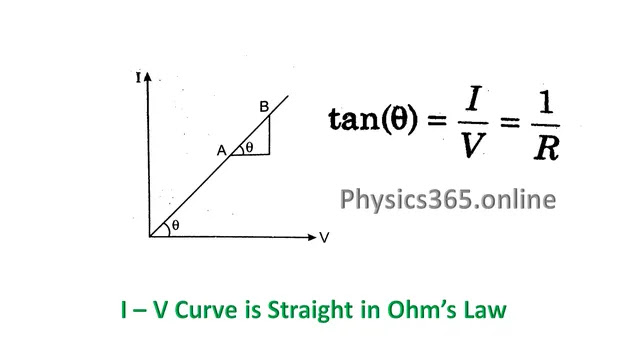
`tantheta = frac{I}{V} = frac{1}{R}`
This shows that current is directly proportional to voltage for an ohmic conductor.
Resistance
The resistance of a conductor is a property of a conductor to oppose the flow of charge through it.
`R = frac {V}{I}`
If V = 1 volt and I = 1 ampere,
`R = frac {1 text {volt}}{1 text {ampere}}`
`R = 1 Omega`
The resistance of a conductor is said to be 1 ohm if the potential difference of 1 Volt produces a current of 1 ampere to flow through it.
For a fixed potential difference, current is inversely proportional to resistance.
1 Ohm’s Definition
According to Ohm’s Law
`I propto V`
`V propto I`
`V = R I`
Where R is a proportionality constant and is called the resistance of the conductor.
`R = frac {V}{I}`
If V = 1 volt and I = 1 ampere
`R = frac {1 text {volt}}{1 text {ampere}}`
`R = 1 Omega`
If a potential difference of 1 volt is applied across the ends of the conductor and a current of 1 ampere flows through it, then the resistance of the conductor is said to be `1 Omega.`
Resistivity
The resistance (R) of a conductor is directly proportional to its length.
`R propto l`
The resistance (R) of a conductor is inversely proportional to its cross-sectional area (A).
`R propto frac{1}{A}`
Combining both relations,
`R propto frac{l}{A}`
`R = rho frac{l}{A}`
Where `rho` is the proportionality constant called resistivity.
It depends on the nature and temperature of the material, but not on the dimensions of the conductor.
According to Ohm’s law
`V = I times R`
Substituting the value of R,
`V = I times rho frac{l}{A}`
`V = J times rho times l`
`E times l = J times rho times l`
`E = J times rho `
therefore,
`E = rho times J `
This equation represents the microscopic form of Ohm’s law.
Here, `frac{1}{rho} = sigma` where `sigma` is called the conductivity.
Where,
I = Current
` J = frac{I}{A}` = current density (current per unit area)
The SI units of the current density are `frac{A}{m^2}`
`rho` = resistivity of the conductor
E = Magnitude of uniform electric field
`l` = Length of conductor
V = Potential difference across ends of the conductor.
Limitations of Ohm’s Law
- Temperature and Physical Conditions: Ohm’s Law is valid only when temperature and physical conditions remain constant. Heating changes resistance and makes the V-I graph non-linear.
- Multiple Voltage Values: In materials like Gallium Arsenide (GaAs), the same current may correspond to different voltages, showing negative resistance.
- Frequency Dependence: In AC circuits, resistance changes with frequency due to capacitors, inductors, and skin effect.
- Extreme Conditions: Superconductors show zero resistance below a critical temperature, while quantum effects at atomic scales make Ohm’s Law invalid.
Solved Numerical
Q. A current of 4 A flows through a conductor having a resistance of 3 Ω. Calculate the potential difference across it.
Answer:
Given:
Current, I = 4 A
Resistance, R = 3 Ω
Using Ohm’s law
V = I R = 4 `times` 3 = 12 V
Hence, the potential difference across the conductor is 12 V.
MCQs on Ohm’s Law
Q 1. Ohm’s law gives the relation between:
(A) Current and time
(B) Voltage and current
(C) Resistance and area
(D) Charge and power
Answer (b)
Frequently Asked Questions
Q. 1 Why does resistance increase with temperature in metals?
Answer: When the temperature increases, the atoms in the metal vibrate more strongly, which opposes the flow of electrons and increases resistance.
Q. 2 Why is Ohm’s Law not valid for semiconductors?
Answer: Semiconductors like diodes and transistors do not show a constant ratio of voltage to current, so they do not obey Ohm’s Law.