Obelia Structure, Life Cycle & Metagenesis Explained (Class 11 Notes + Diagram + MCQs)
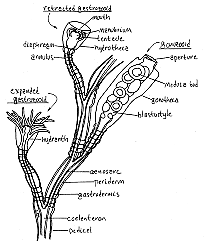 |
| labelled diagram of Obelia |
Introduction
Obelia is a marine, colonial cnidarian that provides a classic example of metagenesis (alternation of generations). It belongs to class Hydrozoa and exhibits two distinct body forms in its life cycle: a sessile polyp and a free-swimming medusa.
This topic is important for Class 11 Biology, practical exams, and competitive exams like NEET, as it helps in understanding life cycles and division of labour in simple multicellular animals.
Classification
-
Phylum: Cnidaria
-
Class: Hydrozoa
-
Order: Leptothecata (Hydroida in older classifications)
-
Genus: Obelia
Habit and Habitat
Obelia is found in marine environments, especially in shallow coastal waters.
-
Habit: Colonial and sessile (polyp stage)
-
Habitat: Attached to rocks, shells, seaweeds, and submerged objects
The colony remains fixed, while reproductive stages become free-swimming
Structure of Obelia Colony
Obelia exists as a branched, tree-like colony composed of interconnected individuals called zooids. The colony shows division of labour, where different zooids perform specialized functions.
Main Parts of the Colony
1. Hydrorhiza
Root-like structure
Anchors the colony to the substratum
2. Hydrocaulus
Upright stem-like axis
Supports and connects the colony
3. Zooids (Polyps)
There are two main types:
(a) Gastrozooids (Hydranths)
Feeding polyps
Possess mouth and tentacles
Capture and digest food using nematocysts
(b) Gonozooids (Gonangia)
Reproductive polyps
Lack mouth and tentacles
Produce buds that develop into medusae
Protective Covering
Each feeding polyp is enclosed in a hydrotheca
Each reproductive polyp is enclosed in a gonotheca
The entire colony is covered by a non-living protective layer called perisarc
Medusa Stage (Sexual Form)
The medusa is the free-swimming sexual stage of Obelia.
Key Features:
Umbrella-shaped (bell-shaped) body
Mouth located on a projection called manubrium
Tentacles present along the margin
Gonads located on radial canals
Usually dioecious (separate male and female individuals)
Life Cycle of Obelia (Step-by-Step)
Obelia shows a complex life cycle involving two alternating phases:
1. Polyp Stage (Asexual Phase)
Colonial and sessile
Gonozooids produce medusae by budding
2. Medusa Stage (Sexual Phase)
Free-swimming
Produces gametes (sperm and ova)
Fertilization occurs in water
3. Development
Fertilized egg forms a zygote
Zygote develops into a ciliated planula larva
Planula settles on a substrate
Develops into a new polyp colony
Metagenesis in Obelia
Metagenesis is the alternation between asexual and sexual generations.
-
Polyp (asexual) → produces medusae
-
Medusa (sexual) → produces gametes
This cycle ensures both rapid reproduction and genetic variation.
Diagram of Obelia
Labelled diagram showing hydrorhiza, hydrocaulus, gastrozooids, gonozooids, and medusa stage.
.png "Labelled diagram of Obelia") |
| Labelled diagram of Obelia |
Identification Features
Marine, colonial organism
Presence of two types of zooids
Chitinous protective covering (perisarc)
Alternation of polyp and medusa stages
Presence of planula larva
Importance
Demonstrates division of labour in simple animals
Classic example of metagenesis
Important for understanding evolution of multicellularity
Useful in zoology practicals and exams
Exam-Oriented Key Points
Shows dimorphism (polyp and medusa forms)
Exhibits tissue-level organization
Life cycle includes planula larva
Reproduction involves both asexual and sexual phases
Frequently Asked Questions (FAQs)
What is Obelia?
Obelia is a colonial marine cnidarian that shows alternation of polyp and medusa forms.
What is metagenesis in Obelia?
It is the alternation between asexual polyp and sexual medusa stages.
Which stage is sessile in Obelia?
The polyp stage is sessile.
Which stage produces gametes?
The medusa stage produces gametes.
What is the planula larva?
It is a free-swimming, ciliated larval stage that develops into a polyp colony.
MCQs
1. Obelia belongs to which class?
(a) Scyphozoa
(b) Hydrozoa
(c) Anthozoa
(d) Calcarea
Answer: (b)
2. Feeding zooids in Obelia are called:
(a) Gonozooids
(b) Gastrozooids
(c) Medusae
(d) Planula
Answer: (b)
3. Obelia shows:
(a) Only sexual reproduction
(b) Only asexual reproduction
(c) Metagenesis
(d) Binary fission
Answer: (c)
4. The larval stage of Obelia is:
(a) Trochophore
(b) Planula
(c) Nauplius
(d) Veliger
Answer: (b)
Keywords (SEO Focus)
Obelia structure class 11, Obelia life cycle explained step by step, metagenesis in Obelia easy explanation, Obelia diagram labelled, cnidaria life cycle notes, hydrozoa examples, Obelia notes for NEET, alternation of generations in Obelia
Final Note
This topic is frequently asked in Class 11 exams, NEET, and practical viva, especially focusing on life cycle and metagenesis. Understanding the alternation between polyp and medusa stages is essential for scoring well.