Petromyzon (Lamprey): Structure, Life Cycle, Diagram, Classification & NEET Notes
 |
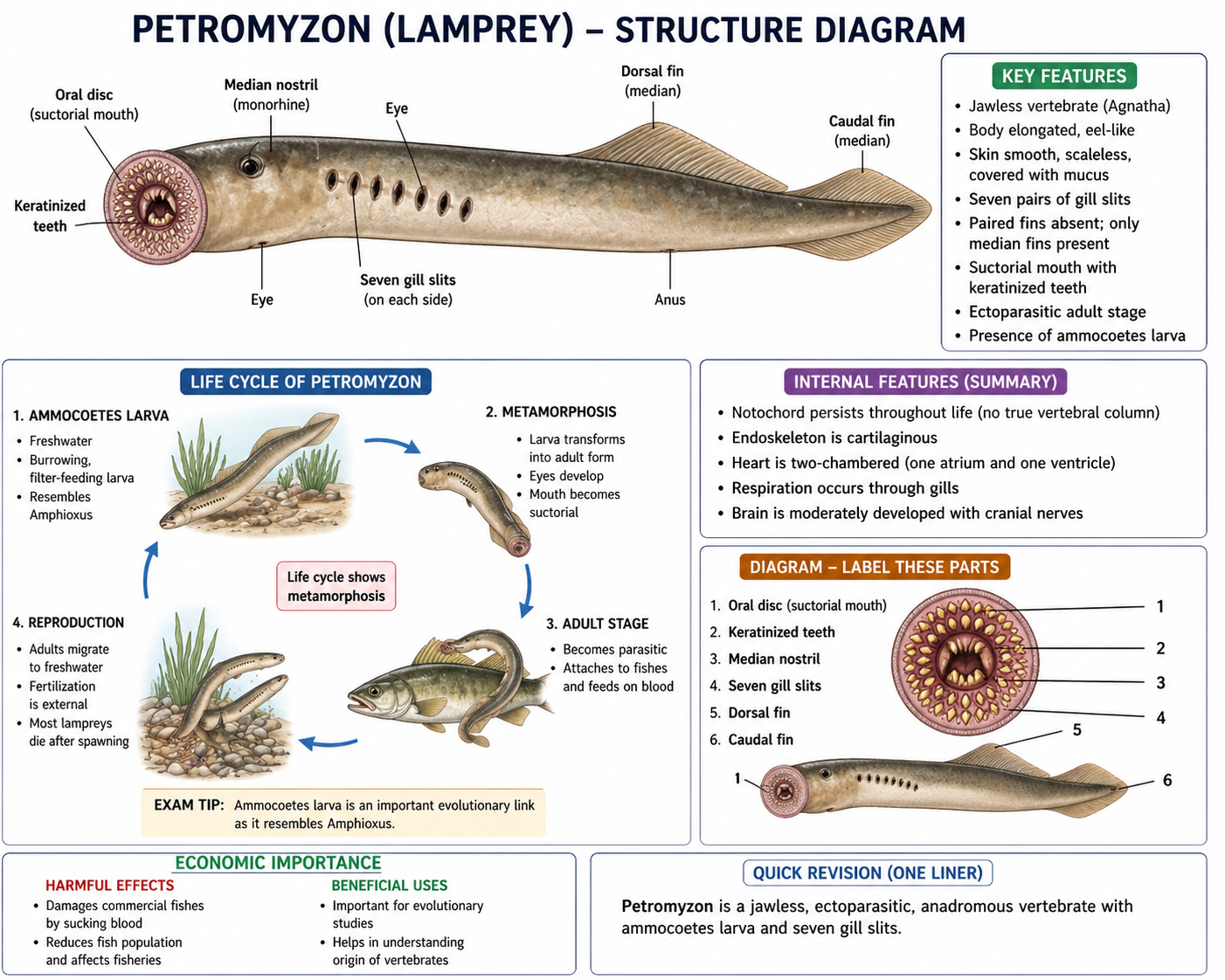
| Labeled diagram of Petromyzon (lamprey) |
🧠 Introduction
In this post, you will learn about Petromyzon (lamprey), its classification, structure, life cycle, and exam-focused points in a clear and easy way.
Petromyzon, commonly called the lamprey, is a primitive jawless vertebrate. It belongs to the group of earliest vertebrates and plays an important role in understanding evolution. Unlike true fishes, lampreys lack jaws and paired fins, which makes them unique and frequently asked in exams like NEET and B.Sc. Zoology.
🧬 Classification
Phylum: Chordata
Subphylum: Vertebrata
Superclass: Agnatha (jawless vertebrates)
Class: Cyclostomata
Genus: Petromyzon
🌊 Habit and Habitat
Lampreys are found in both marine and freshwater environments. Many species are anadromous, meaning they migrate from the sea to freshwater rivers for reproduction.
Adult lampreys are ectoparasites. They attach to fishes using their suctorial mouth and feed on blood and body fluids.
👉 Exam Tip: “Anadromous + Ectoparasite” is a very common question pair.
🔍 External Structure
.jpg "labelled lampray diagram") |
| Petromyzon (Lamprey) labelled diagram |
The body of Petromyzon is elongated, cylindrical, and eel-like, adapted for swimming.
Skin is smooth, scaleless, and covered with mucus (protection + reduces friction)
Mouth is circular and suctorial, with keratinized teeth for attachment
A single median nostril (monorhine condition) is present
-
Seven pairs of gill slits are present on each side
-
Paired fins are absent; only median fins are present
👉 Exam Tip: No jaws + no paired fins = Cyclostomata identification
🫀 Internal Features
-
Notochord persists throughout life (no true vertebral column)
-
Endoskeleton is cartilaginous
-
Heart is two-chambered (one atrium and one ventricle)
Respiration occurs through gills
Brain is moderately developed with cranial nerves
👉 Important Point: Persistence of notochord is a key primitive character.
🖼️ Diagram (What to Label in Exam)
If asked to draw Petromyzon, label these parts:
Oral disc (suctorial mouth)
Keratinized teeth
Median nostril
Seven gill slits
Dorsal fin
Caudal fin
👉 Tip: Even a simple labeled diagram can fetch extra marks in practical exams
🔄 Life Cycle (Very Important)
The life cycle of Petromyzon shows metamorphosis and is frequently asked in exams.
1. Ammocoetes Larva
Freshwater, burrowing, filter-feeding larva
Resembles Amphioxus (very important evolutionary link)
2. Metamorphosis
Larva transforms into adult form
Eyes develop and mouth becomes suctorial
3. Adult Stage
Becomes parasitic
Attaches to fishes and feeds on blood
4. Reproduction
Adults migrate to freshwater
Fertilization is external
Most lampreys die after spawning
👉 Exam Tip: Ammocoetes larva = most repeated question
✨ Key Features (Quick Revision)
Jawless vertebrate (Agnatha)
Suctorial mouth with keratinized teeth
Seven pairs of gill slits
No paired fins
Presence of ammocoetes larva
Ectoparasitic adult
📊 Economic Importance
Harmful Effects
Damages commercial fishes by sucking blood
Reduces fish population and affects fisheries
Beneficial Uses
Important for evolutionary studies
Helps in understanding origin of vertebrates
🎯 Exam Booster MCQs
Q1. Petromyzon belongs to which class?
(a) Pisces
(b) Amphibia
(c) Cyclostomata
(d) Reptilia
Answer: (c)
Explanation: Petromyzon is a jawless vertebrate placed in Cyclostomata.
Q2. How many gill slits are present in Petromyzon?
(a) 5 pairs
(b) 6 pairs
(c) 7 pairs
(d) 8 pairs
Answer: (c)
Explanation: Seven pairs of gill slits are a characteristic feature.
Q3. Ammocoetes larva resembles which organism?
(a) Frog
(b) Amphioxus
(c) Fish
(d) Reptile
Answer: (b)
Explanation: It resembles Amphioxus, showing evolutionary importance.
❓ Frequently Asked Questions
What is Petromyzon?
👉 A jawless, eel-like vertebrate known as lamprey.
Why is ammocoetes larva important?
👉 It resembles Amphioxus and shows evolutionary significance.
Why are lampreys called primitive vertebrates?
👉 Because they lack jaws and paired fins and retain the notochord.
🚀 Final Revision Tip
👉 Remember this line for exams:
“Petromyzon is a jawless, ectoparasitic, anadromous vertebrate with ammocoetes larva and seven gill slits.”