Coulomb’s Law is one of the most fundamental concepts in Class 12 Physics under Electrostatics. It explains how electric charges interact with each other and helps us understand the force between charged objects. A clear understanding of Coulomb’s Law is essential for RBSE board exams as well as competitive exams like JEE and NEET. In this article, you will learn the definition of Coulomb’s Law, its formulas, real-life examples, and important concepts in a simple and easy-to-understand way.
Coulomb’s Law Definition
 |
| Coulomb’s Law |
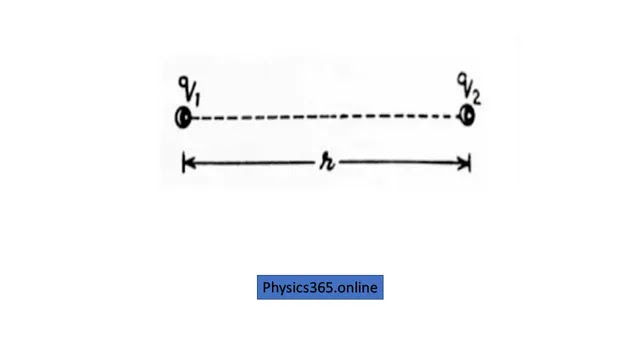
Coulomb’s Law states that the electrostatic force between two stationary point charges is directly proportional to the product of their charges and inversely proportional to the square of the distance between them, following the inverse square law of force. It describes both attractive (opposite charges) and repulsive (like charges) forces.
This law was discovered by Charles-Augustin de Coulomb.
Formula:
`F propto frac{1}{r^2}` eq. (2)
Combine eq. (1) and eq. (2)
`F propto frac{q_1q_2}{r^2}`
Final Formula
`F = frac{k q_1q_2}{r^2}` ……….eq. (3)
Where
k = Electrostatic Constant (or Coulomb Constant)
`k = frac{1}{4pi epsilon_0}`
`k = 9 times 10^9 frac{N m^2}{C^2}`
`epsilon_0 = text{Electrical permittivity of free space}`
`epsilon_0 = 8.854 times 10^{-12} frac{C^2}{N m^2}`
Vector Form of Coulomb’s Law
`vec{F}_{12} = frac{1}{4pi epsilon_0} frac{q_1q_2}{r^2} hat r_{12}`
Where
- `vecF_{12}` is the force on charge `q_1` due to charge `q_2.`
- `hat r` is the unit vector from `q_2` to `q_1`.
- The force acts along the line joining the two charges.
- It is repulsive for like charges and attractive for unlike charges.
- Forces on two charges are equal in magnitude and opposite in direction.
Units and Dimensions of k
From eq. 3
`F = frac{k q_1q_2}{r^2}`
`k = frac{F r^2}{q_1 q_2}`
Thus, units of the Coulomb Constant k
`k = frac{N m^2}{C^2}`
For the dimension of the Coulomb Constant k
`k = frac{F r^2}{q_1 q_2}`
`k = frac{[M^1 L^1 T^{-2}] [L^2]}{[A^1 T^1] [A^1 T^1]}`
`k = [M^1 L^3 T^{-4} A^{-2}]`
Units and Dimension of `epsilon_0`
`epsilon_0 = 8.854 times 10^{-12} frac{C^2}{N m^2}`
`epsilon_0 = frac{1}{4 pi K}`
`epsilon_0 = frac{1}{[M^1L^3T^{-4}A^{-2}]}`
`epsilon_0 = [M^{-1}L^{-3}T^{4}A^{2}]`
Key Points of Coulomb’s Law
- Direction: The electrostatic force always acts along the straight line joining the centres of the two charges. Like charges (both positive or both negative) repel each other, while unlike charges (one positive and one negative) attract each other.
- Permittivity: The constant in Coulomb’s law is commonly expressed using permittivity. It is written as `frac{1}{4 pi epsilon_0}`, where `epsilon_0` represents the permittivity of free space – a measure of how the medium (vacuum) affects the electric force between charges.
- Vector Form: In exams, Coulomb’s law in vector form shows both magnitude and direction. The force between two charges is equal in magnitude and opposite in direction along the line joining them.
- Limitations: It only applies to static point charges.
Principle of Superposition of Charges
`vecF = vecF_1 + vecF_2 + vecF_3 …+vecF_n`
Important points
- Each force is calculated using Coulomb’s law.
- Forces are added vectorially (not algebraically).
- Very important for solving numerical problems.
Effect of Medium on Coulomb’s Law
Limitation of Coulomb’s law
(i) It is used only for static charges (Charges at rest).
(ii) Coulomb’s law is true only for point charges (very small charges).
(iii) Coulomb’s law is valid when the distance is much greater than the size of the charges.
(iv) Valid when charges behave as point charges (distance much larger than size).
Applications of Coulomb’s Law
- Photocopiers & Laser Printers: Devices like photocopiers and laser printers use electrostatic charges to attract toner (ink powder) onto paper. The force between charged particles follows Coulomb’s Law, helping the ink stick in the correct pattern.
- Electrostatic Spray Painting: Used in car painting and furniture polishing. Paint particles are given a charge, and the object is positively charged. Due to the Coulomb force, paint spreads evenly and reduces wastage.
- Air Purifiers (Electrostatic Filters): Air purifiers use charged dust particles and oppositely charged plates to remove impurities using electrostatic force.
- Lightning: Lightning is a natural example of electrostatic force. Charges build up between clouds and the ground, and when the force becomes strong enough, a spark (lightning) occurs.
- Static Electricity (Balloon & Paper): If you rub a balloon against your hair and then move it close to tiny paper bits, they get pulled toward it. This happens because the balloon becomes electrically charged, and the electrostatic force (explained by Coulomb’s Law) attracts the neutral paper pieces.
- Touchscreens (Capacitive Screen): Modern smartphones work on capacitive touch technology. When your finger touches the screen, it disturbs the existing electric field. This change in charge distribution – governed by Coulomb’s Law – helps the device detect your touch.
- Dust Attraction on Screens: Electronic screens like TVs and mobiles often gather dust over time. This is because they develop small static charges on their surface, which attract lightweight dust particles via electrostatic forces.
- Chemical Bonding (Basic Idea): At a microscopic level, the attraction between electrons and protons inside atoms is governed by electrostatic force, which follows Coulomb’s Law.
Unit of Charge
The S.I. unit of charge is coulomb (C). It is represented by C.
The formula of electric charge
`text{Charge} = text{Current × time}`
`Q = I times t`
Thus, the dimensions of electric charge,
`Q = [M^0L^0T^1A^1]`
Since Coulomb is a large unit. Thus, the units of charge can be represented as follows
`1 mu C = 10^{-6} C`
`1 n C = 10^{-9} C`
`1 p C = 10^{-12} C`
The unit of charge in the CGS system is stat Coulomb of Franklin.
`1 C = 3 times 10^9` esu
The other unit of charge is Faraday (not Farad) where
1 F = 96500 C
Q. What is the SI unit of electric charge?
Ans. The SI unit of electric charge is the Coulomb and it is represented by the symbol C.
Q. What is the formula to find the electric charge?
Ans. The formula of electric charge is Q = I`times`t
Q. Define electric charge.
Ans. Electric charge is the property of subatomic particles that lets them experience a force when placed in an electric and magnetic field.
Some Important Facts Related to Charges
(i) Every charged particle has mass, but not every massive particle has charge. This means that the existence of a charge is not possible without mass, but mass is possible without charge. A photon is a massless and chargeless particle. Neutrons have mass but zero charge. But every charged particle has some mass.
(ii) Charges at rest produce only an electric field, while moving charges produce both electric and magnetic fields. When charges accelerate, they emit electromagnetic radiation into the surrounding space.
Coulomb’s Law Questions
Q. Two point charges A and B having charges `+ Q` and `- Q` respectively, are placed at a certain distance apart, and the force acting between them is F. If 25% charge of A is transferred to B, then the force between the charges becomes.
(a) `frac{9 F}{16}`
(b) `frac{16 F}{9}`
(c) `frac{4 F}{3}`
(d) F
Q. A total charge Q is broken into two parts `Q_1` and `Q_2` and they are placed at a distance R from each other. The maximum force of repulsion between them will occur, when
(a) `Q_2 = frac{Q}{R}, Q_1 = Q – frac{Q}{R}`
(b) `Q_2 = frac{Q}{4}, Q_1 = Q – frac{2Q}{3}`
(c) `Q_2 = frac{Q}{4}, Q_1 = Q – frac{3Q}{4}`
(d) `Q_1 = frac{Q}{2}, Q_2 = frac{Q}{2}`
Ans.
(d) `Q_1 = frac{Q}{2}, Q_2 = frac{Q}{2}`
Q. Two charges +2C and +6C are repelling each other with a force of 12 N. If each charge is given – 2C charge, then the value of the force will be :
(a) 4 N (attractive)
(b) 4 N (Repulsive)
(c) 8 N (Repulsive)
(d) Zero
Ans.
(d) Zero
Questions and Answers
What is Coulomb’s Law?
What is the formula for Coulomb’s Law?
What does `q_1` and `q_2` represent in Coulomb’s Law?
What does r represent in Coulomb’s Law?
What is k in Coulomb’s Law?
What are the properties of electric charge?
Give an example of the conservation of electric charge.
What are the limitations of Coulomb’s Law?
What is the unit of electric charge in the CGS system?
Questions for You
Q. Is repulsion a true test of electrification?
Q. Why repulsion is the only test for electrification?
Numerical Questions on Coulomb’s Law