Euspongia (Bath Sponge): Classification, Habit, Habitat, Canal System & Identification
.jpg "Euspongia (Bath Sponge): Classification, Habit, Habitat, Identification & Importance") |
euspongia-diagram |
👉 In this physics365.in article we will discuss about Euspongia or Spongia withd the help of a diagram and also its classification, habit, habitat, structure, canal system, reproduction, identification, and exam-focused questions, which will help you in your exams and you can make your preparation easier.
🧠 Introduction
Euspongia is a marine sponge belonging to phylum Porifera, commonly known as the bath sponge due to its soft and highly absorbent body.
It is one of the simplest multicellular animals, lacking true tissues and organs. Because of its structure and economic importance, it is a very important specimen in zoology practical exams.
🔬 Systematic Classification
Phylum: Porifera
Class: Demospongiae
Order: Keratosa
Genus: Euspongia
🌍 Habit and Habitat
Habitat
- Found in shallow marine water
- Attached to rocky substratum
- Common in tropical and subtropical seas
Distribution
- Eastern Mediterranean
- West Indies
- USA
- Asia
- Australia
👉 Widely distributed in warm seas (cosmopolitan)
Habit
- Sedentary (non-motile)
- Attached to rocks by spongin fibers
- Filter feeder (feeds by filtering water)
🧬 External Characters (Key Features)
- Commonly called bath sponge
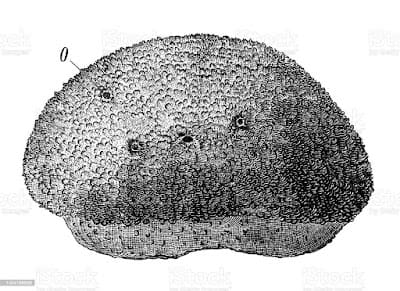
- Body shape: irregular, globular, or cup-shaped
- Color: dark brown or black
- Surface contains:
- Ostia (small pores) → water enters
- Oscula (large openings) → water exits
- Skeleton made of spongin fibers
- Highly porous body
⚙️ Canal System (Most Important Topic)
- Water enters through ostia
- Passes through internal canals
- Leaves through oscula
👉 Euspongia shows leuconoid canal system
👉 This is the most advanced and complex type in sponges
🔄 Comparison of Canal Systems (Save this for exams)
Type: Asconoid → Simplest → Direct flow
Type: Syconoid → Moderate complexity
Type: Leuconoid → Most complex → Maximum surface area for filtration
👉 Helps in:
- Feeding
- Respiration
- Waste removal
🧪 Reproduction
- Asexual reproduction:
- Fragmentation
- Gemmules
👉 Shows high regeneration ability
💰 Economic Importance
Beneficial Uses
- Used as a bath sponge
- High water absorption capacity
- Used for cleaning and washing
- Used in offices for:
- Wetting stamps
- Counting papers/currency
Biological Importance
- Acts as a filter feeder
- Helps in cleaning marine water
- Maintains ecosystem balance
🔍 Identification (Practical Exam)
Euspongia can be identified by:
- Presence of oscula and ostia
- Soft spongin skeleton
- Porous body
- Irregular/cup-shaped structure
- Marine habitat
👉 Hence, the given specimen is identified as Euspongia
❓ FAQs
Q1. What is Euspongia?
Answer: A marine sponge belonging to phylum Porifera.
Q2. Why is it called bath sponge?
Answer: Due to its soft and absorbent body used for bathing.
Q3. Which class does it belong to?
Answer: Demospongiae
Q4. Is it freshwater or marine?
Answer: Marine organism
Q5. Example of Euspongia?
Answer: Euspongia officinalis
Q6. How does it reproduce?
Answer: Asexually by fragmentation and gemmules
🎤 Viva Questions
- What is spongin?
- Define osculum
- What type of symmetry is present?
- What is canal system?
- What type of canal system is found in Euspongia?
📝 Objective Questions (MCQs)
Euspongia belongs to which phylum?
a) Coelenterata
b) Porifera
c) Annelida
d) Mollusca
Answer: b
Explanation: Euspongia is a sponge, and all sponges belong to phylum Porifera.
Class of Euspongia is:
a) Calcarea
b) Demospongiae
c) Hexactinellida
d) Hydrozoa
Answer: b
Explanation: Euspongia belongs to class Demospongiae, which includes most sponges.
Skeleton of Euspongia is made of:
a) Calcium
b) Silica
c) Spongin
d) Chitin
Answer: c
Explanation: Its skeleton is made of spongin fibers, giving it softness and flexibility.
Large opening in sponge is called:
a) Ostia
b) Osculum
c) Mouth
d) Pore
Answer: b
Explanation: Osculum is the large opening through which water exits.
Euspongia is:
a) Free living
b) Parasitic
c) Sedentary
d) Flying
Answer: c
Explanation: It remains attached to a surface and does not move.
Euspongia canal system is:
a) Asconoid
b) Syconoid
c) Leuconoid
d) None
Answer: c
Explanation: Leuconoid is the most advanced canal system in sponges.
Sponges show which type of symmetry?
a) Bilateral
b) Radial
c) Asymmetrical
d) Spherical
Answer: c
Explanation: Most sponges, including Euspongia, are asymmetrical.
Euspongia is mainly found in:
a) Freshwater
b) Desert
c) Marine water
d) Air
Answer: c
Explanation: It is a marine organism found in seas.
🎯 Conclusion
Euspongia is an important marine sponge with a simple body structure but significant biological and economic value. Its leuconoid canal system, spongin skeleton, and porous body make it a key specimen for zoology practical exams.
🟢 Free Section: