Hydra: Morphology, Histology, Nutrition, and Reproduction
 |
| hydra diagram |
Introduction
In this post, you will learn about Hydra, including its morphology, histology, nutrition, reproduction, locomotion, regeneration, and importance in a simple and exam-oriented way. Hydra is an important topic for Class 11 Biology, NEET preparation, practical exams, and viva questions.
Classification of Hydra
Hydra belongs to the phylum Cnidaria because it possesses specialised stinging cells called cnidocytes and shows radial symmetry.
Habit and Habitat of Hydra
Hydra is a solitary freshwater organism commonly found in ponds, lakes, ditches, and slow-moving streams. It usually remains attached to aquatic plants, stones, or submerged objects with the help of its basal disc.
Although Hydra generally remains attached to a surface, it can also move slowly when required.
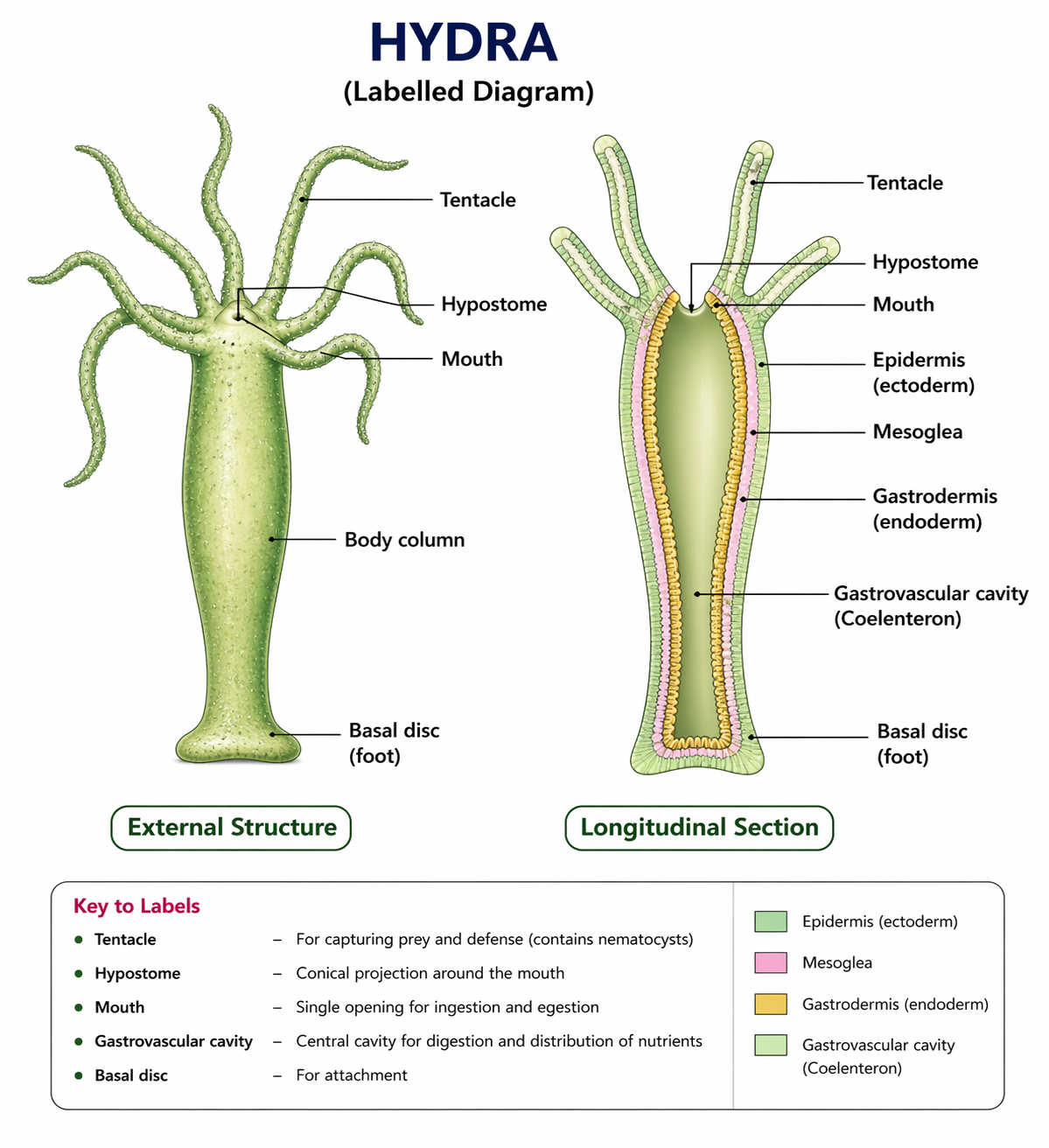
Hydra Labelled Diagram
Suggested diagrams to include:

External morphology of Hydra
Budding in Hydra
Structure of a nematocyst
These diagrams improve understanding, practical preparation, and image SEO.
External Morphology of Hydra
Hydra has a soft, cylindrical, tubular body with radial symmetry.
Main Parts of Hydra
Basal Disc
Also called the foot
Helps in attachment to the substratum
Body Column
Main cylindrical part of the body
Encloses the gastrovascular cavity
Hypostome
- A cone-shaped elevation is present at the oral end
Mouth
Located at the tip of the hypostome
Used for both ingestion and egestion
Tentacles
Long, slender projections surrounding the mouth
Usually 6–10 in number, though the number may vary
Help in food capture and defense
Cnidocytes and Nematocysts
Hydra contains specialized stinging cells called cnidocytes. Each cnidocyte contains a nematocyst.
Functions of Nematocysts
Capture prey
Protection and defense
Immobilization of small organisms
Cnidocytes are the characteristic feature of cnidarians.
Body Wall and Histology of Hydra
Hydra is diploblastic, meaning its body develops from two germ layers.
Layers of the Body Wall
Epidermis (Ectoderm)
Functions:
Protection
Movement
Contains cnidocytes
Gastrodermis (Endoderm)
Functions:
Digestion
Enzyme secretion
Absorption of nutrients
Mesoglea
Thin, jelly-like non-cellular layer present between epidermis and gastrodermis
Provides support and elasticity
Gastrovascular Cavity in Hydra
The central cavity of Hydra is called the gastrovascular cavity or coelenteron.
Functions
Digestion of food
Distribution of nutrients
Gas exchange
Hydra has only one opening, which acts as both mouth and anus.
Nutrition in Hydra
Hydra shows holozoic and carnivorous nutrition. It feeds mainly on small aquatic organisms.
Steps of Nutrition in Hydra
Capture of Food
Tentacles capture prey with the help of nematocysts.
Ingestion
Food enters the body through the mouth.
Digestion
Extracellular digestion occurs first in the gastrovascular cavity.
Intracellular digestion occurs inside nutritive cells.
Absorption
Digested nutrients are absorbed and distributed throughout the body.
Egestion
Undigested food is removed through the mouth.
Respiration and Excretion in Hydra
Respiration
Respiration occurs by simple diffusion through the body surface.
Excretion
Nitrogenous wastes, mainly ammonia, diffuse out directly into the surrounding water.
Hydra does not possess specialized respiratory or excretory organs.
Nervous System of Hydra
Hydra has a primitive nervous system called a nerve net.
Features
No brain or central nervous system
Nerve cells are distributed throughout the body
Helps in simple responses to stimuli
Reproduction in Hydra
Hydra reproduces both asexually and sexually.
Asexual Reproduction in Hydra
Budding
Budding is the most common method of reproduction in Hydra.
Process
A small outgrowth or bud develops on the body wall.
The bud grows gradually.
Tentacles and mouth develop.
The mature bud detaches and forms a new Hydra.
Sexual Reproduction in Hydra
Sexual reproduction usually occurs during unfavorable environmental conditions.
Important Points
Most species are monoecious, though some may be dioecious.
Testes and ovaries produce gametes.
Fertilization forms a zygote.
The zygote develops into a new individual.
Regeneration in Hydra
Hydra possesses a remarkable power of regeneration.
Even small body fragments can regenerate into complete individuals. This regenerative ability is mainly due to the presence of interstitial stem cells.
Hydra is therefore widely used in developmental biology and regeneration research.
Locomotion in Hydra
Although Hydra generally remains attached to a surface, it can move slowly.
Methods of Locomotion
Looping or Somersaulting
The body bends and flips forward.
Gliding
Movement occurs slowly with the help of the basal disc.
Identification Features of Hydra
Cylindrical tubular body
Radial symmetry
Tentacles surrounding the mouth
Presence of cnidocytes and nematocysts
Diploblastic body organization
High regenerative capacity
Importance of Hydra
Biological Importance
Model organism for regeneration studies
Useful in stem cell research
Helps in understanding early animal evolution
Ecological Importance
Part of freshwater food chains
Indicator of freshwater ecosystem health
Why Hydra is Important for Exams
Frequently asked in Class 11 Biology exams
Important for NEET foundation concepts
Common topic in practical examinations and viva
Useful for understanding basic animal organization
Quick Revision Points
Hydra belongs to phylum Cnidaria.
Hydra is diploblastic and radially symmetrical.
Specialized stinging cells are called cnidocytes.
Digestion is both extracellular and intracellular.
Asexual reproduction occurs mainly by budding.
Hydra shows high regenerative ability.
Respiration and excretion occur through diffusion.
Viva Questions
What type of symmetry does Hydra show?
Answer: Radial symmetry
Explanation: Body parts are arranged around a central axis.
What are nematocysts?
Answer: Stinging capsules present inside cnidocytes.
Explanation: They help in prey capture and defense.
How does Hydra reproduce asexually?
Answer: By budding
Explanation: A bud develops on the body wall and detaches to form a new individual.
Why is Hydra important in research?
Answer: Due to its regenerative ability and simple body organisation.
Explanation: It is useful in developmental and stem cell studies.
MCQs on Hydra
Which cell in Hydra is responsible for stinging?
Answer: (c) Cnidocyte
Explanation: Cnidocytes contain nematocysts used for stinging and prey capture.
Hydra belongs to which phylum?
Answer: (b) Cnidaria
Explanation: Hydra possesses cnidocytes, the characteristic feature of cnidarians.
What type of body organization is seen in Hydra?
Answer: (b) Diploblastic
Explanation: Hydra has two germ layers — ectoderm and endoderm.
Hydra reproduces asexually by:
Answer: (b) Budding
Explanation: Budding is the most common mode of asexual reproduction in Hydra.
Keywords
hydra morphology, hydra histology, hydra nutrition, hydra reproduction, hydra regeneration, hydra budding, hydra labelled diagram, cnidocyte in hydra, hydra notes class 11, cnidaria characteristics, hydra NEET notes, diploblastic animals, nematocysts function