Table of Contents
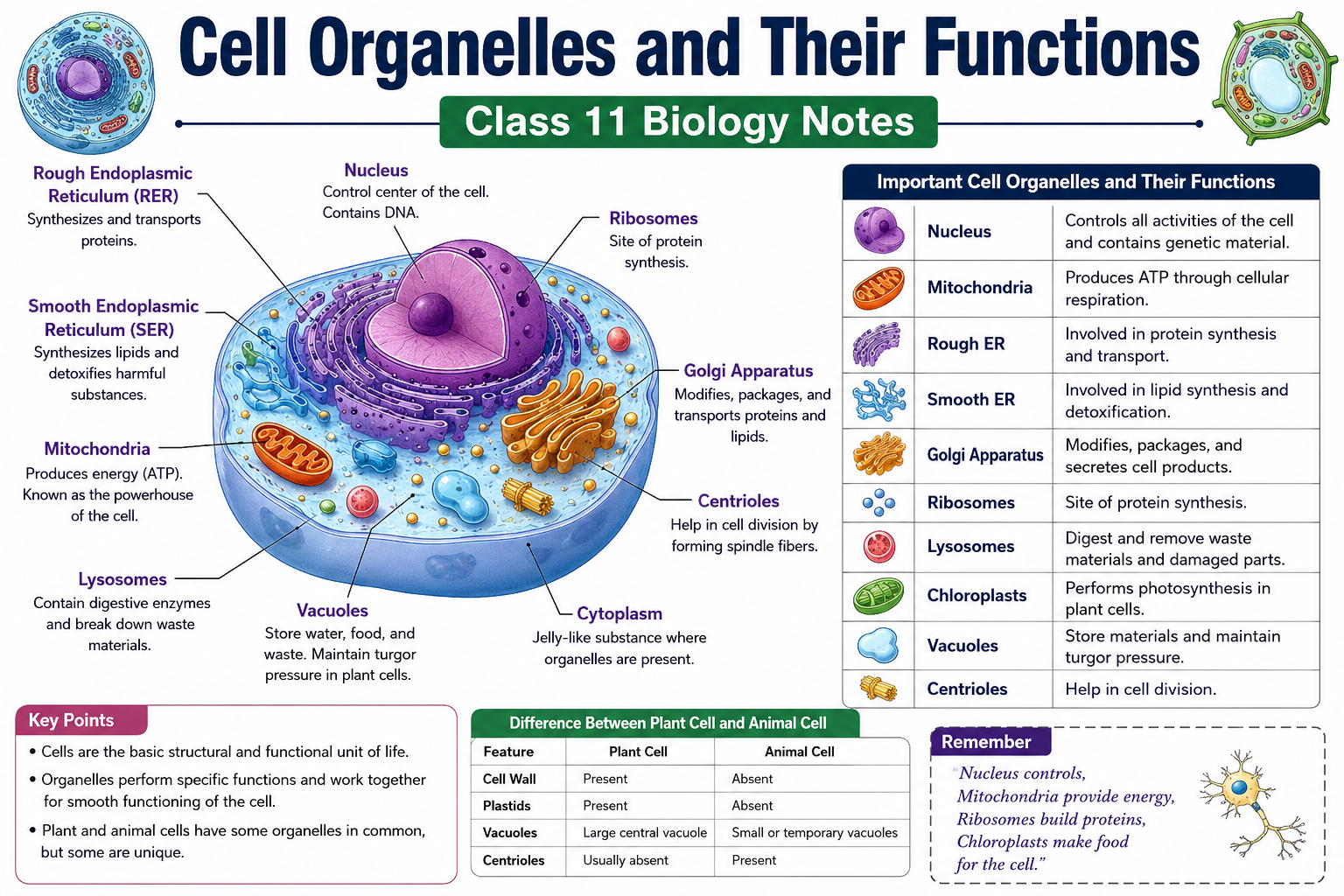
ToggleCell Organelles and Their Functions | Class 11 Biology Notes
 |
| Cell Organelles and Their Functions | Class 11 Biology Notes |
Introduction
In this post, you will learn about cell organelles and their functions, including the nucleus, mitochondria, endoplasmic reticulum, Golgi apparatus, ribosomes, lysosomes, plastids, vacuoles, and other important structures in a simple and exam-oriented way. Cell organelles are an important topic for Class 11 Biology, NEET preparation, practical exams, and viva questions.
Cell organelles are specialized structures present inside cells that perform specific functions necessary for cell survival and proper functioning.
What are Cell Organelles?
Cell organelles are membrane-bound or non-membrane-bound structures found in the cytoplasm of cells.
Functions of Cell Organelles
Maintain cellular activities
Help in metabolism
Store substances
Produce energy
Synthesize proteins
Different organelles perform different functions inside the cell.
Types of Cell Organelles
Cell organelles are broadly classified into:
Membrane-Bound Organelles
Nucleus
Endoplasmic reticulum
Golgi apparatus
Lysosomes
Vacuoles
Mitochondria
Plastids
Non-Membrane-Bound Organelles
Ribosomes
Centrioles
Cytoskeleton
Nucleus
The nucleus is the control center of the cell.
Structure of Nucleus
Nuclear membrane
Nucleoplasm
Chromatin
Nucleolus
Functions of Nucleus
Controls cellular activities
Stores genetic material (DNA)
Regulates cell division
Helps in protein synthesis
Most eukaryotic cells possess a well-defined nucleus.
Mitochondria
Mitochondria are known as the “powerhouse of the cell.”
Structure
Double membrane
Inner membrane forms cristae
Matrix contains enzymes and DNA
Functions of Mitochondria
Production of ATP by cellular respiration
Energy release
Regulation of metabolism
Mitochondria contain their own DNA and ribosomes.
Endoplasmic Reticulum (ER)
The endoplasmic reticulum is a network of membranous tubules and sacs.
Types of ER
Rough Endoplasmic Reticulum (RER)
Ribosomes present on surface
Helps in protein synthesis
Smooth Endoplasmic Reticulum (SER)
Ribosomes absent
Helps in lipid synthesis and detoxification
Golgi Apparatus
Golgi apparatus consists of flattened membranous sacs called cisternae.
Functions of Golgi Apparatus
Modification of proteins and lipids
Packaging of cellular products
Secretion
Formation of lysosomes
It is also called the packaging center of the cell.
Ribosomes
Ribosomes are small non-membranous structures composed of RNA and proteins.
Functions of Ribosomes
Protein synthesis
Ribosomes may occur freely in cytoplasm or attached to rough ER.
Lysosomes
Lysosomes are membrane-bound sacs containing digestive enzymes.
Functions of Lysosomes
Intracellular digestion
Removal of damaged organelles
Defense against foreign particles
Lysosomes are sometimes called “suicidal bags” of the cell.
Plastids
Plastids are double-membrane organelles found mainly in plant cells.
Types of Plastids
Chloroplasts
Green plastids containing chlorophyll
Site of photosynthesis
Chromoplasts
Colored plastids
Store pigments
Leucoplasts
Colorless plastids
Store food materials
Vacuoles
Vacuoles are membrane-bound sacs filled with cell sap.
Functions of Vacuoles
Storage of food and waste
Maintenance of turgor pressure
Osmoregulation
Plant cells usually possess large central vacuoles.
Centrosome and Centrioles
Centrosome contains two centrioles arranged perpendicular to each other.
Functions
Formation of spindle fibers during cell division
Organization of microtubules
Centrioles are generally absent in higher plant cells.
Cytoskeleton
The cytoskeleton is a network of protein filaments present in cytoplasm.
Functions
Maintains cell shape
Helps in movement
Provides mechanical support
Peroxisomes
Peroxisomes contain oxidative enzymes.
Functions
Breakdown of fatty acids
Detoxification of harmful substances
Removal of hydrogen peroxide
Difference Between Plant Cell and Animal Cell Organelles
| Feature | Plant Cell | Animal Cell |
|---|---|---|
| Cell wall | Present | Absent |
| Plastids | Present | Absent |
| Vacuole | Large central vacuole | Small vacuoles |
| Centrioles | Usually absent | Present |
Important Functions of Cell Organelles
| Organelle | Main Function |
|---|---|
| Nucleus | Control of activities |
| Mitochondria | ATP production |
| Ribosomes | Protein synthesis |
| Golgi apparatus | Packaging and secretion |
| Lysosomes | Digestion |
| Chloroplast | Photosynthesis |
| Vacuole | Storage |
Identification Features of Cell Organelles
Nucleus contains DNA
Mitochondria produce energy
Ribosomes synthesize proteins
Chloroplasts contain chlorophyll
Golgi apparatus packages substances
Lysosomes contain digestive enzymes
Why Cell Organelles are Important for Exams
Frequently asked in Class 11 Biology
Important for NEET preparation
Diagram-based questions are common
Important for understanding cell biology
Quick Revision Notes
Nucleus controls cellular activities.
Mitochondria are called powerhouse of the cell.
Ribosomes are sites of protein synthesis.
Chloroplasts perform photosynthesis.
Golgi apparatus helps in packaging and secretion.
Lysosomes contain digestive enzymes.
Vacuoles maintain turgor pressure.
Viva Questions
Which organelle is known as the powerhouse of the cell?
Answer: Mitochondria
Explanation: They produce ATP through cellular respiration.
Which organelle performs photosynthesis?
Answer: Chloroplast
Explanation: Chloroplast contains chlorophyll required for photosynthesis.
What is the function of ribosomes?
Answer: Protein synthesis
Explanation: Ribosomes synthesize proteins required by the cell.
Why are lysosomes called suicidal bags?
Answer: Because they contain digestive enzymes.
Explanation: These enzymes can digest damaged cell components.
MCQs on Cell Organelles
Which organelle is called the control center of the cell?
(a) Ribosome
(b) Nucleus
(c) Lysosome
(d) Vacuole
Answer: (b) Nucleus
Explanation: The nucleus controls cellular activities and contains DNA.
Which organelle produces ATP?
(a) Golgi apparatus
(b) Ribosome
(c) Mitochondria
(d) Vacuole
Answer: (c) Mitochondria
Explanation: Mitochondria produce energy in the form of ATP.
Ribosomes are mainly involved in:
(a) Digestion
(b) Respiration
(c) Protein synthesis
(d) Excretion
Answer: (c) Protein synthesis
Explanation: Ribosomes synthesize proteins.
Chlorophyll is present in:
(a) Lysosome
(b) Vacuole
(c) Chloroplast
(d) Nucleus
Answer: (c) Chloroplast
Explanation: Chloroplast contains chlorophyll pigment.
Frequently Asked Questions (FAQs)
Which organelles are present only in plant cells?
Plastids and large central vacuoles are characteristic of plant cells.
Which organelle contains DNA besides nucleus?
Mitochondria and chloroplasts contain their own DNA.
What is the function of Golgi apparatus?
Golgi apparatus modifies, packages, and secretes cellular products.
Which organelle is responsible for intracellular digestion?
Lysosomes perform intracellular digestion.
Suggested Diagrams
Animal cell labelled diagram
Plant cell labelled diagram
Structure of mitochondria
Structure of chloroplast
Golgi apparatus diagram
These diagrams improve understanding and exam preparation.
Keywords
cell organelles and their functions, cell organelles class 11, cell organelles notes for NEET, mitochondria function, nucleus structure and function, golgi apparatus function, ribosomes function, plant cell organelles, animal cell organelles, cell biology notes